Transient Convergence
The result of transient analysis depends on three factors: convergence, accuracy, and speed. In practice, one of the three factors must be traded off. For example, without loss of convergence, a fast simulation implies that the accuracy must be low. Conversely, solver settings of high accuracy and high performance can lead to a convergence failure or require a long simulation time. Nevertheless, convergence is the top priority and cannot be traded off.
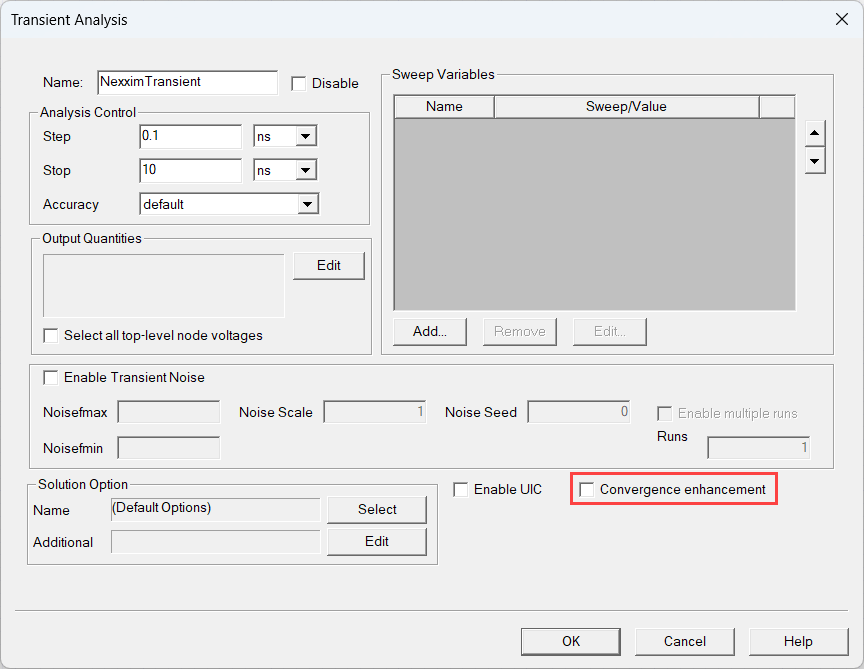
For cases that are difficult to converge with the default method, Nexxim provides two alternative convergence enhancement methods: Max convergence enhancement and Balanced convergence enhancement.
-
Max convergence enhancement applies fixed values on some parameters to maximize the chance of convergence. See Transient Analysis options reference for details. This method can be enabled by setting tran.convergence_enhancement=1. If Nexxim still fails to converge with this method, use Transient Diagnostics to locate problematic device information.
-
Balanced convergence enhancement applies dynamic values on parameters to balance performance, convergence, and accuracy. The method can be enabled by the checkbox in the Transient Analysis set up window or by setting tran.auto_conv_enhancement = 1. This method has high accuracy and better performance compared to Max convergence enhancement, but may fail to solve extreme cases like highly nonlinear circuits. If Nexxim fails to converge with Balanced convergence enhancement, please retry Max convergence enhancement.