
Time Domain Representation of a Multitone RF Source
The nonlinear functional component part of a nonlinear behavioral element (See Figure 2 in the topic The Equivalent Model for Nonlinear Behavioral Components ) is modeled in the time domain. An important step for calculating IMD products in the time domain is to derive an equivalent envelope time domain representation for a given bandpass RF multi-tone source.
Complex Envelope of an RF Source
An RF multi-tone source typically contains a fundamental carrier and at least one additional carrier. The equivalent source voltage S(t) of an RF source that has a total of n carriers (including the fundamental carrier) may be expressed as:


= The complex envelope of the signal S(t)
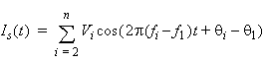
= In-phase envelope signal
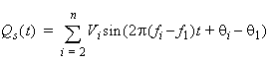
= Quadrature-phase envelope signal


Where:
fi = The ith carrier frequency
f1 = fc = Fundamental carrier frequency
q1 = 0
qi = The ith carrier phase
Pi = The ith carrier available input power
P1 = Fundamental carrier available input power
Nonlinear Output Voltage
The nonlinear output voltage is calculated in the time domain as:

Where:

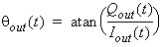




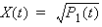

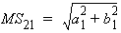
The source resistance Rin and the load resistance Rout default to 50W, but they can be individually specified for each input and output, respectively.
Constraints on the Carrier Frequency
The accuracy of the envelope multi-tone analysis puts constraints on the minimum spacing between carrier frequencies:


,  , i,j
= 1,2...,n
, i,j
= 1,2...,n
k = positive or negative integer.
Envelope multitone frequency domain analysis results may lose accuracy when Df is too large. In general, the condition Df << f1 must hold for accurate results.