
IMD Calculations for Mixers with MIXERSPURS Data Tables
When a carrier mixes with the local oscillator frequency in a mixer, intermodulation and harmonic frequency components is generated at the output of the mixer. These harmonic frequency components are called Mixer Spurs.
Generally, mixing can produce energy at all frequencies equal to:

where:
fRF is the frequency of the carrier at the input of the mixer
fLO is the frequency of the local oscillator
NRF and NLO are integers representing the RF and LO multipliers respectively.
You can control how many spurs get generated by specifying the MAXORDER, MINF, MAXF, and MINP parameters for each mixer, where:
MAXORDER: maximum order of spurs, 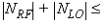 MAXORDER
MINF: minimum spur frequency (spurs below MINF are ignored)
MAXF: maximum spur frequency (spurs above MAXF are ignored)
MINP: minimum spur power, (spurs below MINP are ignored)
The power of a spur at the output of a mixer is calculated using the MIXERSPURS data table provided for the mixer. Once generated, each spur is carried through the remainder of the system with all mismatches taken into account. Figure 4 shows a representative mixer spurs table. Essentially, the rows in Figure 4 represent relative power levels for harmonic RF multipliers, and the columns represent relative power levels for harmonic LO multipliers. The image power level can also be specified.
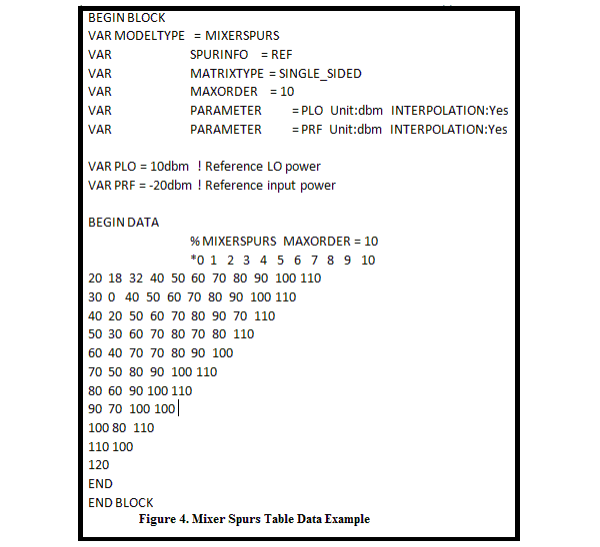
It is always assumed that mixer spur tables are obtained at the output IF port when the RF and IF ports of a mixer are both terminated in 50W and a single-tone RF source (with a given frequency and available input power) is applied to the mixer’s RF port.
Mixer Spurs Indices
Mixer spurs indices can be viewed at any external port or voltage/power probe to indicate the spectral origin in terms of each RF and LO multiplier through all mixing stages.
The following assumptions are made when computing these indexes:
- Mixer spurs are calculated only for the principal carrier. If more than one mixer is present in the system, the calculation proceeds in this manner: new mixer spurs are generated using only the principal carrier at the input to each mixer. Previously generated mixer spurs (available at the input of each mixer) are translated through each mixer using the principal integer multipliers NRF and NLO, (NRF = 1, NLO = -1), without generating any additional Mixer Spurs. This assumption is based on the fact that additional spurs are typically either filtered out or too weak compared to the spurs generated by the principal RF carrier.
- The index calculations do not account for IMD harmonics generated by nonlinear two port components in the system such as amplifiers.