Solenoid System
Background - Solenoid System
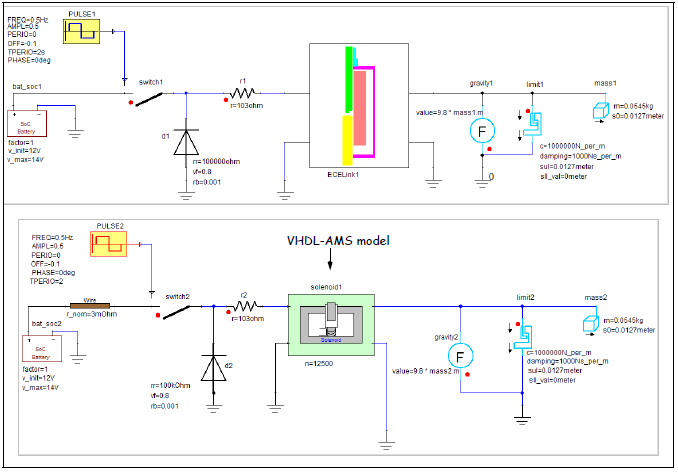
Twin Builder allows the use of finite element data generated from a Maxwell circuit simulation through the ECE (Equivalent Circuit Export) link. In this example, two solenoid models are simulated. The first model uses finite element data from the ECE link (Maxwell model) and the second uses an approximated model developed using VHDL-AMS (VHDL-AMS model).
The solenoid is powered by the SoC battery and is controlled by a switch that functions through a pulse model. Each solenoid model has two electrical pins for input, and two translational pins for output. Note that solenoid models can also convert energy in the other direction, mechanical to electrical. The mechanical force, measured using a force meter, is used to displace a translational mass representing the plunger. The opposing force of gravity on the plunger is represented by a force (f=mass*9.8m/s²), and the displacement of the plunger is controlled by a limit stop model.
The VHDL-AMS model uses an idealized equation based on the input current value and the position of the plunger to determine the flux linkage in the solenoid and the corresponding force on the plunger. The Maxwell model is more accurate since it uses the finite element data that models fringing and saturation effects.