
Eddy Currents and Skin Depth
The inductances and resistances computed during an resistance matrix solution are different from those computed for the equivalent DC case. The eddy current simulator includes these eddy effects when it computes inductance during a resistance solution. The following figure shows how current density (J) varies with position along the radius (r) of the conductor cross-section for both cases:
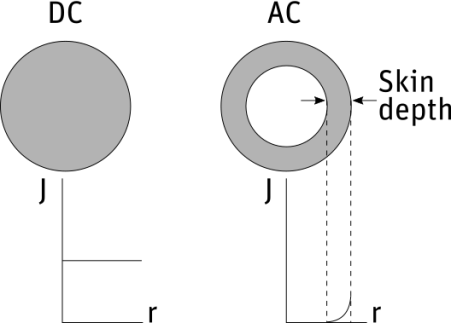
The current density in the DC case (on the left) is evenly distributed throughout the cross-section of the conductor. The current density in the AC case (on the right) is distributed close to the surface due to skin concentration of currents. Since the area through which current can flow is smaller, resistance to the current is higher in the AC case than in the DC case.
In the DC example, eddy currents do not occur because the magnetic field created by the current flowing through the conductor is static. In the AC example, the oscillating magnetic field induces currents in the conductors. These induced currents affect the computation of inductance, causing it to be different from (generally lower than) the DC case. At higher frequencies the magnetic field can propagate completely outside the conductor, whereas current (the movement of electrons) still must travel in the conductor, though with a smaller cross-sectional area. Therefore, at higher frequencies, there is less interaction of the magnetic field with the conductor, so it is impeded less, thus there is less inductance. The inductance flattens out because the magnetic field still interacts with the surface of the conductor but has avoided pulling fields along through the metal.