
Ambient Temperature Guidelines
For Convection boundaries, the amount of heat that will flow out of or into the face of the solid object is a function of the following three quantities:
- Thermal power being dissipated or absorbed (heat flux expressed as power per unit area)
- Convection film coefficient
- Temperature difference between the object face and the surrounding ambient air or fluid
For Uniform Film Coefficients:
When you specify an assumed uniform film coefficient, the ambient temperature can be any value that makes sense for the application (such as the outdoor air temperature, the interior temperature of a room, or the inlet temperature of air or fluid being forced through an enclosure by a fan). In most electronics enclosures or rotating machines (motors, alternators, or generators) it is appropriate to specify the temperature of the incoming air at the enclosure inlets.
For Non-Uniform (Imported) Film Coefficients:
When importing heat transfer coefficients (HTCs) from Icepak, it is imperative that the ambient temperature specified for the Convection boundary in the Mechanical design be consistent with the Icepak fluid region's inlet temperature. The reasons are as follows:
- Icepak solves coupled fluid flow / heat transfer multiphysics analyses. Heat transfer from solid objects to the fluid region is by conduction that takes into account the motion of the fluid to move the heat more rapidly than conduction through a static fluid would. No convective film coefficient is assumed. The heat flux is directly computed based on available thermal power or assigned temperatures, material conductivities, and fluid motion.
- Mechanical convection boundaries approximate heat flow in or out of a fluid region without modeling the fluid or the flow pattern. Instead, assumed ambient temperatures and film coefficients (or HTCs) are used to approximate the heat transfer.
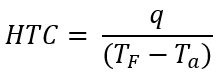
- HTCs are not directly imported into Mechanical because they are not a direct product of the Icepak solution. It is the Heat Flux and Temperature results at each element face that are actually imported from Icepak into Mechanical. The HTCs are then calculated from these Icepak results based on the ambient Temperature value you specify for the Mechanical Convection boundary. The following equation is used:
- q is the heat flux through the solid element face in units of power per unit area (from results of the Icepak solution)
- TF is the solid element face temperature (from the results of the Icepak solution)
- Ta is the ambient temperature you specify in the Mechanical design's Convection dialog box
- In order for the calculated HTCs to be valid, Ta must be consistent with the inlet fluid temperature that was specified in Icepak and that resulted in the imported heat flux values. If the ambient temperature in Mechanical is not consistent with the inlet fluid temperature in Icepak, the calculated HTCs will not be accurate.
- For complex scenarios, there may be multiple openings in the Icepak air region, and different openings can have differing inlet fluid temperatures. In such cases, the following recommendations apply:
- If the air is well mixed before reaching the convection boundaries of interest, set the ambient temperature of the Convection boundary in Mechanical to the average of the inlet temperatures in Icepak. If the inlet velocities and areas differ, calculate a weighted average based on the relative volumetric flow rates of each inlet.
- If certain model faces are positioned to be predominately influenced by the flow from a particular inlet, apply multiple convection boundaries to selective model faces. Do not use the global AmbientTemp value for the convection boundaries, Instead, for each separate boundary assignment, numerically specify the ambient temperature equal to the Icepak inlet temperature that is most significant for the selected faces.
- If the correlation between inlet temperatures and convection faces is not readily apparent, use Icepak, instead of Mechanical, to determine temperature results for all model variants. Icepak solutions require more time and computer resources, but they eliminate concerns about the ambient temperature uncertainty.
where: