
Sinusoidal Voltage Source
This is an independent voltage source with an exponentially damped sinusoidal waveform of the voltage as a function of time. The "+" and "-" symbols are used to mark the polarity of the source.
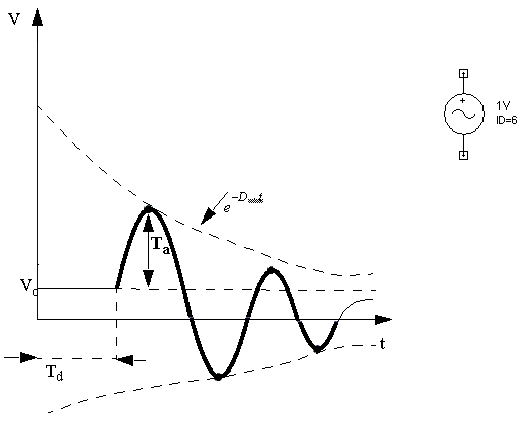
The equation describing the waveform is

where
- V0 is Offset voltage in Volts.
- Va is the peak amplitude in Volts.
- VFreq is the signal frequency if type is TIME.
- Td is the delay time in seconds if type is TIME.
- Phase is the signal phase delay if type is TIME.
- Df is the damping factor in 1/seconds if type is TIME.
If the type is POSITION, the frequency should be calculated based on the respective spatial periodicity, taking into account the fact that "t" in the above equation is measured in degrees for rotational type of motion and in the user-defined geometry units for translational type of motion. The delay and damping factor should also be interpreted accordingly.
If the type is SPEED, the frequency should be calculated based on the respective speed periodicity, taking into account the fact that "t" in the above equation is measured in rpm for rotational type of motion and in the user-defined geometry units per second for translational type of motion. The delay and damping factor should also be interpreted accordingly.
Using the Alternating Flux (AF) Model
For transient simulations whose excitation is the sinusoidal voltage source, the DC flux linkage component may take a very long time to decay, especially for a device with a large time constant. Setting AF=1 enables the AF model to be used by the Maxwell transient solver.
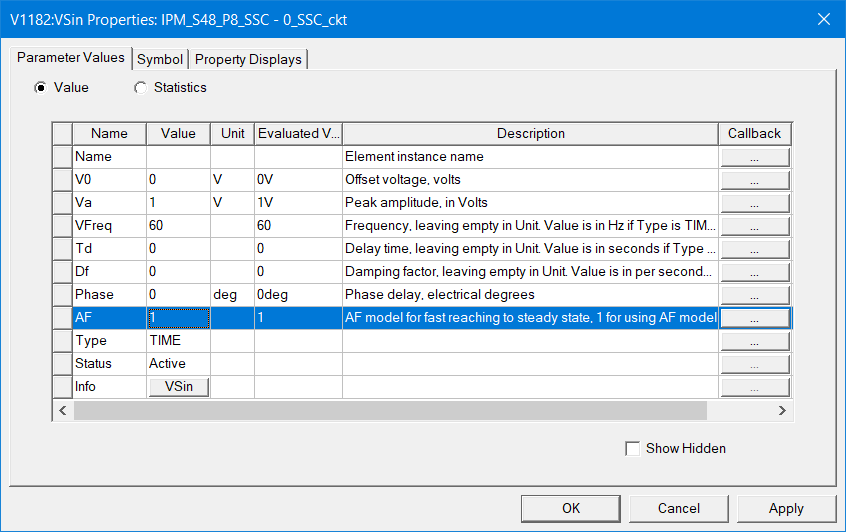
The AF model algorithm adds an additional voltage component to the original voltage definition during the first half-cycle to quickly eliminate the DC flux linkage, thus speeding up simulation solutions.