Real and Imaginary Components for an Eddy Current Solution
In general, you must enter a magnitude and phase for all AC voltages, currents, and other boundary or source quantities. But if the magnitude and phase angle of a quantity are functions of position, specify the functions in terms of real and imaginary components (x+jy). The "x+jy" description of a phasor indicates that the phasor is the sum of two components - a sinusoid that peaks at wt = 0°and a sinusoid that peaks at wt = 90°.
- The "x" component of the phasor is the real component and is represented by a phasor that lies on the real axis of the complex plane.
- The "y" component is the imaginary component and is represented by a phasor that lies on the j-axis of the complex plane.
The real and imaginary components of a three phase system are shown below:
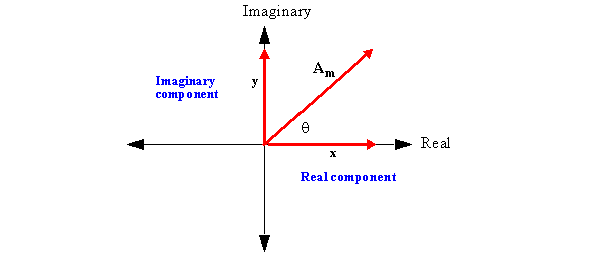
They are related to the magnitude and phase of a sinusoid in this way:

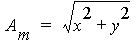
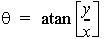
where the real and imaginary components are
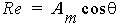
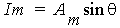
For a symmetric three-phase system, q = 0, 120, 240 degrees, respectively.
For a frequency domain simulation (eddy current), all sources (currents, fields) must have the same frequency. Therefore, the simulation frequency is specified as a global input parameter.
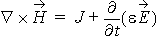
In simulations where the electromagnetic radiation is included the displacement, currents are included in the calculation. In such a situation, the dependency between H and J is given by the following equation: