
Maxwell Partial Model Coupling with Workbench
This feature allows Maxwell 2D and 3D partial model coupling with Workbench applications such as Mechanical and Thermal. The full model geometry and solution can be extracted through symmetry from the partial model. Symmetry boundary conditions are used to solve problems with symmetry and, thus, allow the users to take advantage of the significantly reduced problem size for a given accuracy.
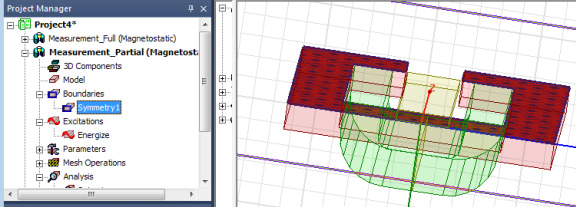
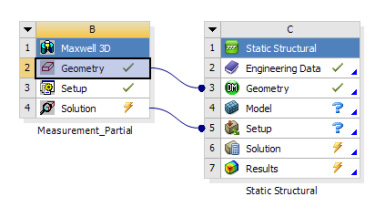
The following conditions must be observed for the Maxwell partial model:
- The model must be physically correct.
- Independent and dependent boundaries must be planar. If there is more than one pair of independent and dependent boundaries, all independents are coplanar and all dependents are coplanar.
- There are at most three mirroring symmetries, which are orthogonal to each other. If there is a pair of independent and dependent boundaries, then only one mirroring symmetry is allowed and it must be perpendicular to the axis of the independent and dependent boundaries.
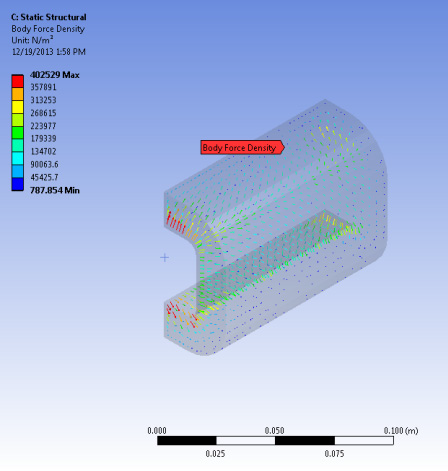
- When the Maxwell side is a partial model and the Mechanical side is full model, full model loss / force will be mapped to the Mechanical side.
- When the Maxwell side is a partial model and the Mechanical side is also a partial model, only partial model loss / force will be mapped to the Mechanical side.
- When setting up loss transfers from Maxwell to WorkBench, if the user wants to map loss density on a face shared by two objects, this face only has to be used once in the setup.
The user must ensure that the Maxwell partial model is physically correct, and that the full model in Workbench Mechanical, Thermal, etc. matches the partial model. The loss/force data from the partial Maxwell model is then mapped to the full model in Workbench Mechanical, etc. for solving. The mapping is handled implicitly.
Related Topics
Symmetry for a Magnetostatic Field Solution
Matching (Independent/Dependent) Boundary for a Magnetostatic Field Solution
Symmetry for an Electric Field Solution
Matching (Independent/Dependent) Boundary for an Electric Field Solution
Symmetry for a Transient Solution
Matching (Independent/Dependent) Boundary for a Transient Solution