Electrostatic Theory
The electrostatic field simulator solves for the electric potential, F(x,y), in this field equation:

where:
- F(x,y) is the electric potential.
- er is the relative permittivity. It can be different for each material.
- eo is the permittivity of free space, 8.854 x 10—12 F/m.
- r(x,y) is the charge density.
This equation is derived from Gauss’s Law and from Faraday’s law of induction. Gauss’s Law indicates that the net electric flux passing through any closed surface is equal to the net positive charge enclosed by that surface. In differential form, Gauss’s Law is:

where D(x,y) is the electric flux density. Because D = ereoE, then

In a static field, as a consequence of Faraday’s law, E = -ÑF. Therefore,

which is the equation that the electrostatic field simulator solves using the finite element method.
After the solution for the potential is generated, the system automatically computes the E-field and D-field using the relations E = -ÑF and D = ereoE.
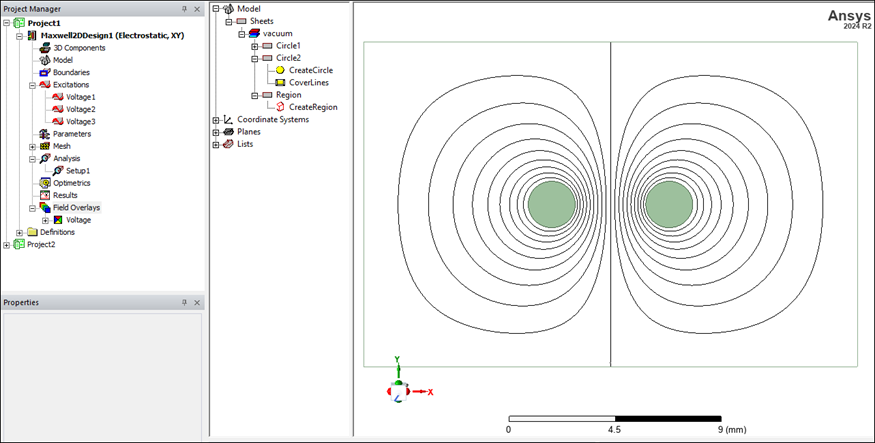
A contour plot of electric potential generated by the electrostatic field simulator is shown below: