
DC Conduction Theory
When a material with a non-zero conductivity is subject to a potential difference, conduction current flows in the material. At all points in the problem space, the current density (J) will be proportional to the electric field (E) that is established due to the potential difference.
J(x,y) = sE(x,y) = -sÑF(x,y)
where
- J(x,y) is the current density.
- E(x,y) is the electric field.
- s is the conductivity of the material in MKS units (S/m).
- F(x,y) is the electric potential.
The equation that the DC conduction field simulator solves is based on the fact that, under steady state conditions, the amount of charge, r, leaving any infinitesimally small region must equal the charge flowing into that region:

The field quantity that DC conduction actually solves for is the electric potential, F, in the following equation:

Note that -sÑF = J.
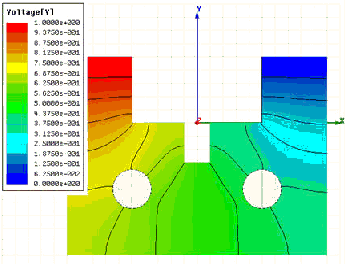
A plot of electric potential that was computed by the DC conduction solver is shown below:
 s
s