
Capacitance in Terms of Charges and Voltages
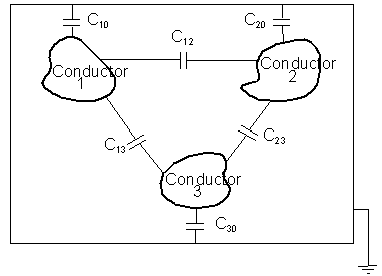
A capacitance matrix represents the charge coupling within a group of conductors — that is, the relationship between charges and voltages for the conductors. Given the three conductors shown below, with the outside boundary taken as a reference, the net charge on each object is
Q1 = C10 V1 + C12(V1 - V2) + C13(V1 - V3)
Q2 = C20 V2 + C12(V2 - V1) + C23(V2 - V3)
Q3 = C30 V3 + C13(V3 - V1) + C23(V3 - V2)
This can be expressed in matrix form as:
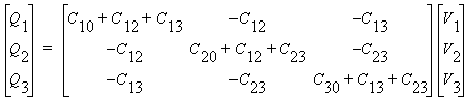
The capacitance matrix above gives the relationship between Q and V for the three conductors and ground. In a device with n conductors, this relationship would be expressed by an n x n capacitance matrix. Capacitance matrix values are specified in farads (coulombs/volt).
If one volt is applied to Conductor 1 and zero volts is applied to the other two conductors, the capacitance matrix becomes
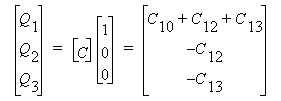
The diagonal elements in the matrix (such as C(1,1)) are the sum of all capacitances from one conductor to all other conductors. These terms represent the self-capacitance of the conductors. Each is numerically equal to the charge on a conductor when one volt is applied to that conductor and the other conductors (including ground) are set to zero volts. For instance, for
C(1,1) = C10 + C12 + C13
the off-diagonal terms in each column (such as C(1,2), C(1,3))
are numerically equal to the charges induced on other conductors in the
system when one volt is applied to that conductor. For instance, in column
one of the example capacitance matrix, C(1,2)
is equal to
-C12. This is equal to the
charge induced on Conductor 2 when one volt is applied to Conductor 1
and zero volts are applied to Conductor 2.
The off-diagonal terms are the negative values of the capacitances between the corresponding conductors (the mutual capacitances). In column one of the example capacitance matrix, the off-diagonal terms represent the capacitances between Conductor 1 and the other two conductors; in column two, the terms represent the capacitance between Conductor 2 and the other conductors; and so forth.
Note that the capacitance matrix is symmetric about the
diagonal. This indicates that the mutual effects between any two objects
are identical. For instance, C(1,3),
the capacitance between Conductor 1 and Conductor 3 (