
Setting HPC and Analysis Options
All analysis parameters are accessed via a single window. The machine list and options settings have been integrated into analysis configurations. The default configuration is for solving on a single, local machine. You can create many analysis configurations for remote and distributed solutions, and switch between them depending on the job being solved. Multiprocessing has been integrated into the machine lists.
To set HPC and Analysis Options:
- Click Tools > Options > HPC and Analysis Options.
You can also access HPC and Analysis Options using the HPC Options icon on the Simulation ribbon.
The HPC and Analysis Options window appears, displaying the Configurations tab.
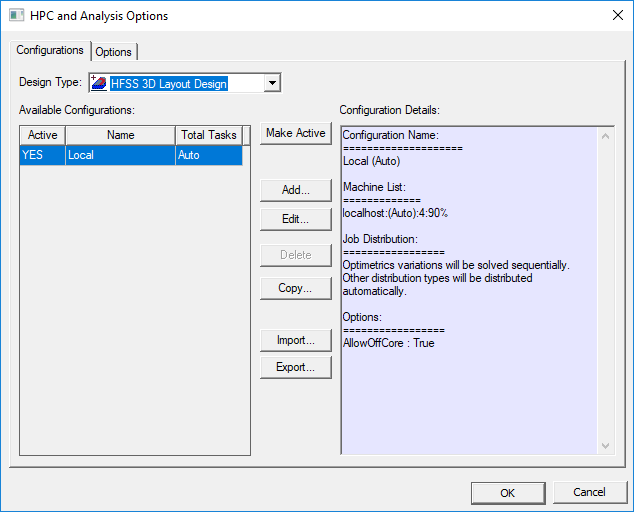
Configurations Tab
Available Configurations are described by Name, whether or not they are Active, and the Total Tasks the configuration can execute.Selecting a configuration from the list displays the details of that configuration in the Configuration Details panel.
From the Configurations tab, select the Design Type to display a list of available configurations for that type.
Configurations must be defined for all design types separately. To use similar analysis parameters for different design types, create separate analysis configurations for each design type. The active configuration is used when solving an analysis for that design type.
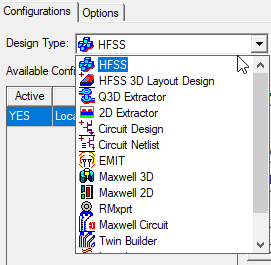
Selecting an Available Configuration
To activate a configuration, select it from the Available Configurations list and click Make Active. The active configuration will be indicated by a YES in the Active column.
Additional options include:
- Add – launches a dialog box to create a new analysis configuration.
- Edit – launches a dialog box to edit the currently selected analysis configuration.
- Delete – deletes the currently selected analysis configuration(s).
Note: You cannot delete the Local configuration.
- Copy – creates a new analysis configuration, and launches a dialog box to edit it. If the dialog box is canceled, the new analysis configuration is not created.
- Import – allows you to import an *.acf file to create an analysis configuration.
Note: Importing analysis configurations always adds the imported analysis configurations to the current design type. If there is a name conflict between an imported analysis configuration and an existing analysis configuration, the imported configuration is renamed and a notification appears.
- Export – allows you to export the selected analysis configurations to an *.acf file. You can then import the configurations into a different design type, or import them on a different machine.
Options Tab
The Options tab in the HPC and Analysis Options dialog box contains general and product-specific settings.
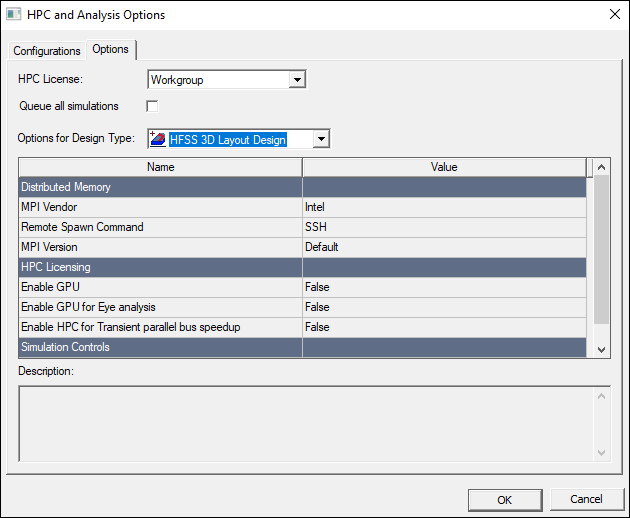
Available options vary by design type. Certain items discussed on this page may not be visible, depending on the currently selected design type.
These options are not specified for, or saved as part of, the current analysis configuration. Instead, they are global and are always in effect for the given design type when both of the following conditions are true:
- A design of the matching design type is being solved.
- You have not specified corresponding overriding batch options on the command line.
From the Options tab, you can:
- Choose the HPC license type
- Enable queuing
- Specify Distributed Memory settings (for example, MPI for certain solvers)
- Set licensing options
- Enable GPU (for Transient, Matrix and SBR+ solves)
- Set the Default Process Priority
Solving with Intel MPI on a single Windows machine does not require MPI installation, but registration of the user's password with Intel MPI on the host is required if using password authentication. Solving with Microsoft MPI on a single Windows machine requires Microsoft MPI to be installed and the MS-MPI Launch Service to be started. These steps are not required for Microsoft MPI analysis on a Windows HPC cluster. Solving with Microsoft MPI on multiple Windows hosts is only supported on a Windows HPC cluster.
Users running on Linux do not need to install MPI manually.
For HPC License, select Auto, Workgroup or Pack.
HPC licensing enables the use of cores and GPUs to accelerate simulations. In general, each core requires one unit of HPC, while each GPU requires eight units. The selected HPC license type determines which license is used, and how units of HPC are converted to license counts.
- Workgroup (formerly "pool") – One HPC workgroup license enables one unit of HPC.
- Pack – One HPC pack license enables eight units of HPC. Additional packs multiply by four, enabling 32, 128, 512,... , in the context of a single simulation.
- Auto – delegate the choice of Workgroup or Pack licensing to the Ansys Licensing Settings tool which is a separate application installed along with Electronics Desktop.
Electronics Desktop products include four units of HPC for each licensed simulation. This means that up to four units can be used without requiring HPC licenses; license counting begins with the fifth unit. For example, a simulation that uses 36 cores requires 32 HPC units after subtracting the four included cores. This simulation will check out 32 HPC workgroup licenses, or two HPC pack licenses.
HPC licenses enable all parallel and distributed simulations, including distributed variations. Distributed variations require a single set of solver licenses, plus HPC to enable the variations.
For HPC Workgroup, distributing N variations requires 8*(N–1) workgroup licenses and, together with the solver licenses, enables up to four HPC units per variation. Each additional set of N workgroup licenses will enable one additional HPC unit per variation. For HPC Pack, distributing N variations requires N–1 pack licenses and, together with the solver licenses, enables up to four HPC units per variation. Each additional set of N pack licenses will enable 8, 32, 128,... additional HPC units per variation.
Ansys licensing supports distributed simulations when Electronics Desktop is called from other Ansys tools, such as optiSLang and Workbench. In such cases, distributed design points (variations) generally use HPC counts as described above.
Licensing for some calling products may include some distributed design points, in which case the total required HPC will be reduced.
If the Queue all simulations check box is selected, the Desktop queues any active simulations for design types that have Save before solving turned off in the General Options and then processes them in order. You can view and change the queue by using Show Queued Simulations.
To configure options:
- For Linux authentication, specify the Remote Spawn command as RSH or SSH (the default).
- Optionally, you can select one of the following from the Default Process Priority drop-down menu:
- Critical (highest) (Not recommended)
- Above Normal (Not recommended)
- Normal (Default)
- Below Normal
- Idle (lowest)
You can also set these values using VB or Python scripts.
For information on editing configurations, see Editing Distributed Machine Configurations.