
Setting DC Resistance and Inductance (RL) Analysis Parameters in Q3D Extractor
To set up a DC Resistance and Inductance (RL) analysis, first add a solution setup.
Then, from the Solve Setup window:
- Select the DC RL tab.
The DC RL options display.
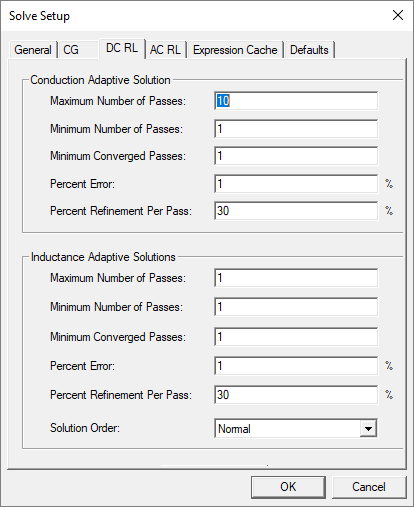
- In the Conductance Adaptive Solution and Inductance Adaptive Solutions areas, specify values for the following:
- Maximum Number of Passes – the maximum number of mesh refinement cycles that you would like Q3D
Extractor to perform. This value is a stopping criterion for the adaptive
solution; if the maximum number of passes has been completed, the adaptive
analysis stops. If the maximum number of passes has not been completed,
the adaptive analysis continues unless convergence criteria are reached.
Important:
The size of the finite element mesh — and the amount of memory required to generate a solution — increases with each adaptive refinement of the mesh. Setting the maximum number of passes too high can result in Q3D Extractor requesting more memory than is available or taking excessive time to compute solutions.
- Minimum Number of Passes – the minimum number of mesh refinement cycles. Q3D Extractor will not stop analysis until after this number of passes has been completed.
- Minimum Converged Passes – the minimum number of passes that must meet convergence criteria before the adaptive analysis will stop.
- Percent Error – the desired solution accuracy. Smaller values produce more accurate but slower solutions; larger values produce less accurate but faster solutions.
- Percent Refinement Per Pass – determines how many tetrahedra are added
at each iteration of the adaptive refinement process. The tetrahedra
with the highest error are refined. The default value is 30%. Note:
Magnetic materials (conducting and non-conducting) affect inductance in the DC RL solution. If magnetic materials are present, and you run more than one inductance adaptive solution, Q3D Extractor will do adaptive solve on both surface and volume meshes. If magnetic materials are present in a model, it is recommended to solve for five or more inductance passes.
- Solution Order – refers to the accuracy level. The solver will give accurate results at the Normal setting for most applications. The High, Higher, and Highest options offer greater accuracy at the expense of speed and memory.
- Maximum Number of Passes – the maximum number of mesh refinement cycles that you would like Q3D
Extractor to perform. This value is a stopping criterion for the adaptive
solution; if the maximum number of passes has been completed, the adaptive
analysis stops. If the maximum number of passes has not been completed,
the adaptive analysis continues unless convergence criteria are reached.
- Click OK.
For designs containing Pulse Width Modulated (PWM) voltages and currents (common in power electronics), an advanced workflow is required to accurately estimate losses in bus bars, connectors, and PCBs. See: Electrothermal Flow for Power Electronics.