
Spherical Cross-Sections
When you set up a spherical surface over which to analyze near or far fields, you specify a range and step size for phi and theta, or for far fields, also Azimuth over Elevation. These indicate the spherical direction in which you want to evaluate the radiated fields. For every value of phi there is a corresponding range of values for theta, and vice versa. This creates a spherical grid. Each grid point indicates a unique direction along a line that extends from the center of the sphere through the grid point. The radiated field is evaluated in this direction. The number of grid points is determined by the step size for phi and theta.
The sphere can be defined according to any defined coordinate system and before or after a solution has been generated.
For parts of the sphere outside of the model region, near-field approximation is calculated. However, if parts of the sphere are inside the model region, the model fields are used to compute interpolated values. A section of the sphere is considered to overlap the model if it lies in the enlarged model region after accounting for symmetry planes.
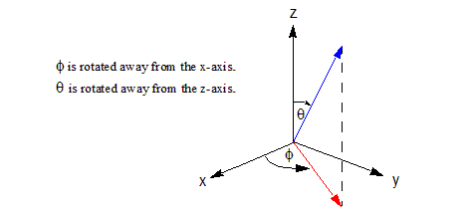
The relationship between phi and theta is shown below.
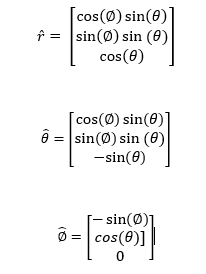
Antenna pattern measurements are calculated in a spherical coordinate system using the following basis vectors:
When HFSS evaluates the radiated fields, it needs at least two directions along which to plot the fields. Therefore, if the step size for phi is zero, then the step size for theta must be greater than zero, and vice versa. This ensures that the fields are plotted in at least two directions.
When setting up the sphere, phi and theta angles must be specified between -360 degrees (deg) and 360 degrees (deg), or the equivalents in radians (rad). If deg nor rad is specified, HFSS assumes the value to be in degrees.
Following are additional guidelines for specifying Phi in the Near Field Radiation Sphere Setup window or the Far Field Radiation Sphere Setup window:
|
Start |
The point where the rotation of phi begins. The Start value must be equal to or greater than one. |
|
Stop |
The point where the rotation of phi ends. The Stop value must be greater than the Start value and less than 360. If the Stop value is equal to the Start value, then HFSS assumes that only one angle should be used and the Step Size value will be ignored. |
|
Step Size |
The number of degrees or radians (spherical grid points) between the sweep of phi. For example, to divide a sweep from 0° to 180° into 10° increments, you would enter 10. Entering zero for the Step Size causes the sweep to consist of one point, the start value. If the Step Size value is zero, then HFSS assumes that only one angle should be used. |
Following are additional guidelines for specifying Theta:
|
Start |
The point where the rotation of theta begins. The Start value must be greater than -90 degrees, or the equivalent in radians. |
|
Stop |
The point where the rotation of theta ends. In classic definition the Stop value must be greater than the Start value and less than or equal to 180 degrees, or the equivalent in radians. In HFSS, you can input 360 degrees. If the Stop value is equal to the Start value, HFSS assumes that only one angle should be used and the Step Size value will be ignored. |
|
Step Size |
The number of degrees or radians (spherical grid points) between the sweep of theta. For example, to divide a sweep from -60 degrees to 60 degrees into 10-degree increments, you would enter 10deg. Entering zero for the number of steps causes the sweep to consist of one point, the Start value. If the Step Size value is zero, then HFSS assumes that only one angle should be used. |
For a discussion of using Azimuth and Elevation, see Setting up a Far Field Infinite Sphere.