
Huray Surface Roughness Model
Surface roughness can increase conductor power losses by more than two times the loss associated with smooth conductors. In Ansys Electronics Desktop, a modification of the standard real-valued Huray surface roughness model is implemented to accurately account for these losses in both the frequency and time domains.
This modification fixes a causality problem with the original Huray model by adding some frequency-dependent reactance to the roughness-enhanced surface impedance. The purpose is to provide a complex-valued causal analytic model that exactly matches the loss results of the original model but is also suitable for time domain computations.
The original Huray model was limited to calculations in the frequency domain and did not account for the effects of roughness on the phase of the transmitted signal. These limitations have been eliminated. The enhanced causal model not only provides accurate broadband modeling of the losses in very rough copper foils (typically used in PCB manufacturing) but also accurately predicts increased phase delay due to the surface roughness.
Essentially, the smooth surface impedance (Zsmooth) is increased by a complex “Huray” factor (Hc), a function of frequency, given by the following equation (1):

where:
- ω is the frequency in radians/second
- ω0 is a corner frequency represented by the equation (2):

- K is a derived constant used to simplify the equation (3):

in which:
- SR is the Hall-Huray surface ratio:

- a is the radius of a spherical nodule
- μr is the relative permeability of the conductor
- μ0 is the permeability of free space

- σ is the electrical conductivity in Siemens/m
- N is the number of nodules
- Af is a unit cell area
Note:aandSRare the two parameters you must enter in theSurface Roughness Modeldialog box when you select the Hurayoption:
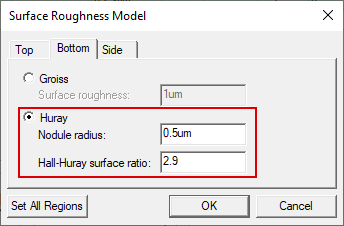
- SR is the Hall-Huray surface ratio:
For more information about this complex causal Huray model (its necessity, background, derivation, proof of accuracy, and consistency with the original real-valued model), see Reference 6 below.
Once the Huray surface roughness factor is determined, the rough surface impedance (Zrough) is determined by the equation (4):

References:
- P.G Huray, S.G Pytel, S.H Hall, F. Oluwafemi, R.I. Mellitz, D. Hua, and P. Ye, "Fundamentals of a 3-D "Snowball" Model for Surface Roughness Power Losses", 11th Annual IEEE SPI Proceedings, May 13 – 16, 2007.
- S.H Hall, S.G. Pytel, P.G Huray, D. Hua, A. Moonshiram, G. Brist, and E. Sijercic, "Multi-GHz, Causal Transmission Line Modeling Methodology with a Hemispherical Surface Roughness Approach", IEEE Transactions on Microwave Theory and Techniques, December 2007 pp 2614 – 2624.
- S.G Pytel, P.G Huray, A. Moonshiram, S.H Hall, R.I Mellitz, G. Brist, F. Oluwafemi, H.M Meyer, L. Walker, and M. Garland, "Analysis of Copper Treatments and the Effects on Signal Propagation", 58th Annual IEEE ECTC, May 26 – 30, 2008, pp 1144 – 1149.
- S.G Pytel, "Multi-gigabit data signaling rates for PWBs including dielectric losses and effects of surface roughness", PhD. Dissertation, University of South Carolina, 2007.
- P.G Huray, O. Oluwafemi, J. Loyer, E. Bogatin, and X. Ye; "Impact of Copper Surface Texture on Loss: A Model That Works", DesignCon 2010, February 1 - 4, 2010.
- J. Eric Bracken, Ansys, Inc., "A Causal Huray Model for Surface Roughness", DesignCon 2012, January 2012.