
The Edge Response
Physical transmitters cannot produce a pure step function. The input to the channel on the transmitter is not a true step function but an edge function, rising or falling. The edge functions ER(t) and EF(t) incorporate the rise time and fall time specified in the eye source. These transition times cannot be zero.
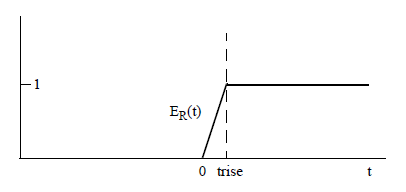
Figure 4. Rising Edge Function E R(t)
By default, the rise and fall times are the same. The eye source can set the rise and fall times to different values.
The edge response w(t) is the response of the LTI system when the input is an edge function.
Both QuickEye and VerifEye run transient analysis to calculate the rising and falling edge responses of the channel.
By default, the solver simulates over a time period of 100 UIs to calculate the edge response. The STEP_RESP_NUM_UI parameter on the Eye Source sets the number of unit intervals needed to allow the response to reach a steady state (high or low).
Despite the formula differences, the term step response is used in the GUI window and in the text of the help topics to represent either the step or edge response.
Figure 5 shows typical rising and falling step responses.
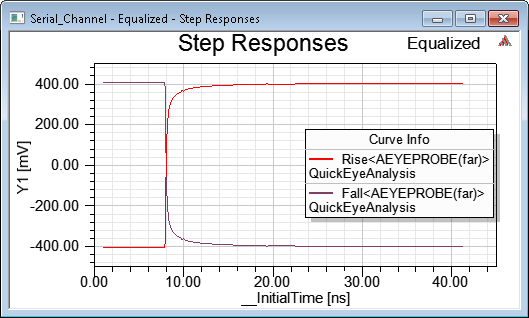
Figure 5. Typical Rising and Falling Step Responses u(t) or Edge Responses w(t)