
Specifying a Generic Equalizer Transfer Function, Pole-Zero Format
A generic equalizer transfer function can be specified using either the pole-zero format or the polynomial format.
With the pole-zero format, you specify the poles and zero frequencies for the generic equalizer rational function, as well as the allowable DC Gain values and a value for the high-frequency peak gain (maximum amplitude of the high-pass filter). As with the legacy CTLE, Nexxim varies the DC Gain to find the value that gives the maximum eye height given the other parameters.





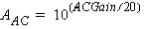
Case 1: The data includes one or more zero frequencies, Z>0. The rational function for this case has the form:
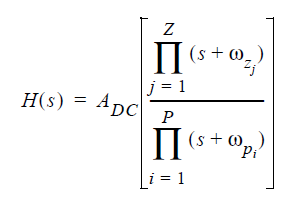
(5)
When P=2 and Z=1, Equation (5) reduces to the legacy case of Equation (3). This case generalizes the legacy formulation of Equation (3) from P=2 and Z=1 to any P>1 and any Z<P. This allows Nexxim to match industry-standard CTLE specifications such as VESA.
Case 2: The data does not have any zero frequencies explicitly specified, Z=0. The rational function has the form:
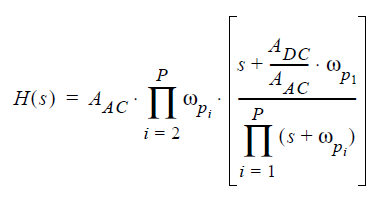
(6)
When P=2, Z=0, and AAC=1, Equation (6) reduces to the legacy case of Equation (2). This case generalizes the legacy formulation of Equation (2) from P=2, Z=0, and AAC=1 to any P>1 and any AAC<1. This allows Nexxim to match industry-standard CTLE specifications such as USB3.1 Gen2.
Note that at DC (s=0, AAC=1), H(s) = ADC as expected.