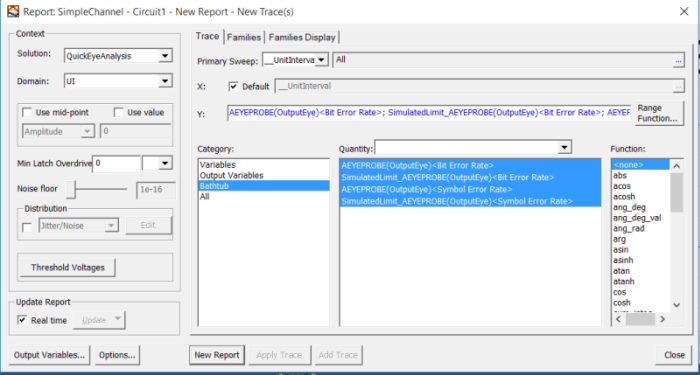
To open the results of a Quick Eye analysis, click
on the Results icon in the Project Manager window and select one of the Create
Report options. There are many ways to plot the data; this topic
gives examples of a Statistical (Sampled) Eye Diagram, a 2D Bathtub plot, standard and statistical Eye diagrams with PAM4 modulation, and a 2D Bathtub plot with PAM4 modulation.
Sampled Eye Diagram
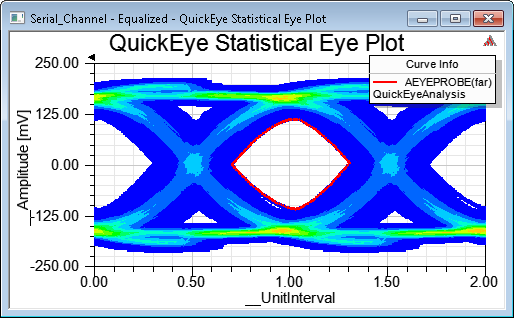
The sampled or statistical eye report generates the eye diagram but does not retain the transient data for further post-processing. The sampled eye diagram plot requires an Eye Scope be present at the appropriate measurement point.
To generate a sampled eye diagram, select Create Statistical Eye Report>Statistical Eye Plot. Select your Quick Eye Analysis as the Solution ; UI as the Domain; Eye as the Category; the appropriate Eye Probe as the Quantity Type; and <none> as the Function.
2D Bathtub BER Plots
To view the data as a 2D bathtub curve, select Create Standard Report>Rectangular Plot. From the Report window, select UI as the Domain and Bathtub as the Category. Click New Report.
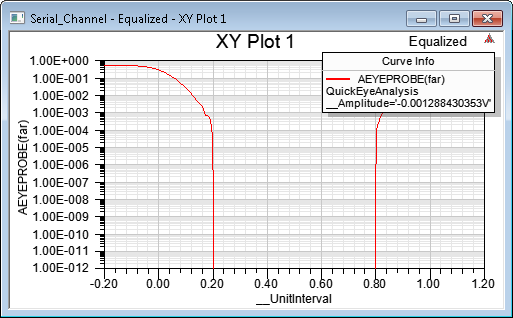
This graph shows the BER at various locations in the unit interval. By default, the amplitude is set at the midpoint of its value range. The BER values are on the Y-axis using logarithmic scaling and a minimum of 1e-16.
2D PAM4 Eye Diagrams
To enable PAM4 modulation, set the modulation parameter in the Eye source to PAM4. Select Gray or Linear for the coding parameter as applicable. When analysis completes, select Create Eye Diagram > Rectangular Plot.
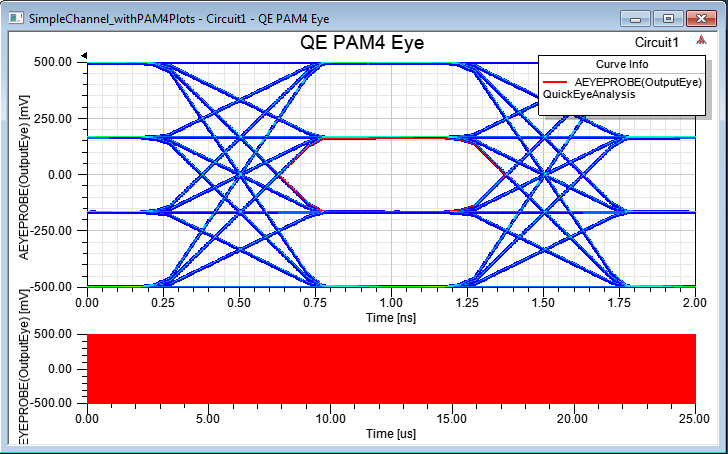
The plot shows four voltage levels, each one corresponding to a transition between two bits. This example uses the default Gray coding: the lowest level represents 00, the next higher level represents 01, the next higher level represents 11, and the highest level represents 10. The four voltage levels form three eyes in the diagram.
Alternatively, select Create Statistical Eye Diagram Report.
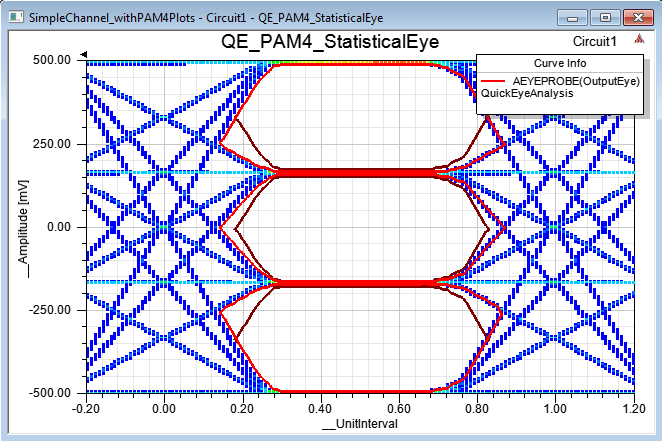
The red lines show the eye openings. The dark lines show the intersection of all three eye openings.
2D PAM4 Bathtub Plots
To enable PAM4 modulation, set the modulation parameter in the Eye source to PAM4. Select Gray or Linear for the coding parameter as applicable. When analysis completes, select CreateStandard Report> Rectangular Plot. From the Report setup, click the Families tab and edit the _EyeOpening family. The entries are -101 (combined error rate), -1 (upper eye error rate), 0 (middle eye error rate) and 1 (lower eye error rate). From the Report window, select UI as the Domain and Bathtub as the Category. Select the <Bit Error Rate> trace to see the bit error rate.
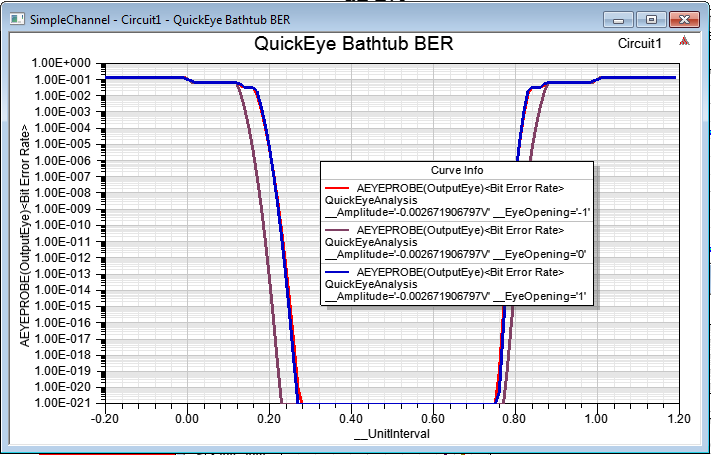
The example plot shows the separate bit error rates for the three PAM4 eyes (-1, 0, and 1 selected).
Thebathtub curve for a PAM4 simulation can show the symbol error rate instead of the bit error rate. With PAM4, a symbol is two bits. The report setup is the same, but now select the <Symbol Error Rate> trace.
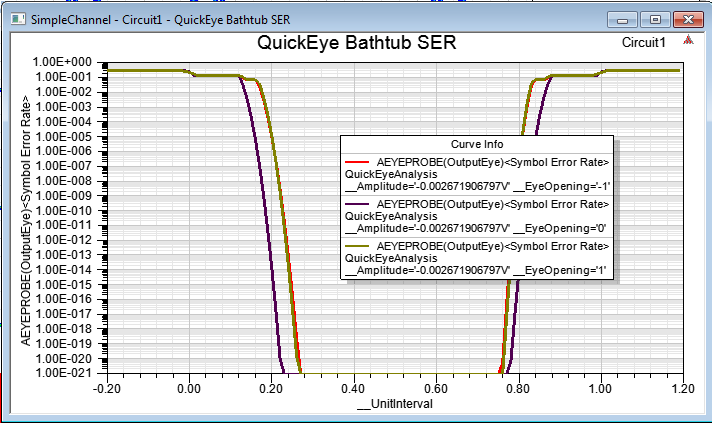
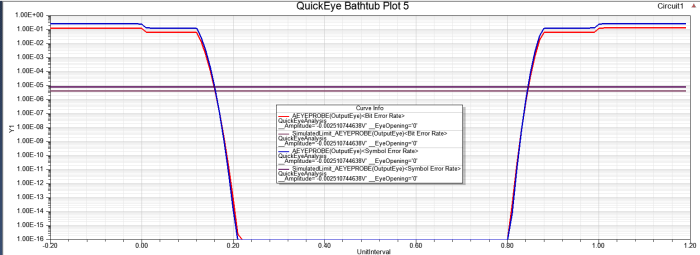
For bathtub curves of QE, distinguish simulated/extrapolated regions using a partitioning horizontal line via the ‘SimulatedLimit’ option that is in available the ‘Quantity’ column. Such processing allows for the robust extrapolation of bathtub curve arising out of QE and AMI analyses.
- BER/SER level of partitioning = 1/bit or symbol_length simulated
- symbol_length = bit_length for NRZ, or, 0.5*bit_length for PAM4