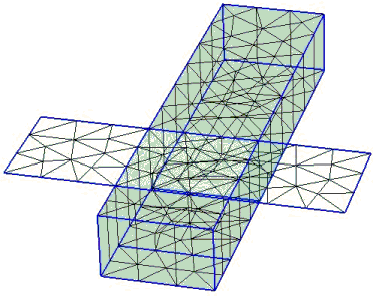
Where polygons from different layers/materials overlap, the mesher decides on the material in the area of intersection based on the following rules:
- For polygons with precedence numbers, the polygon with lower precedence takes priority over those polygons with higher precedence.
- If the mesher cannot resolve the priority using the precedence attribute, it considers conductivities. The polygon with the higher conductivity takes priority over those polygons with lower conductivity.
- If conductivities are the same, the stackup index is used. Objects higher in the stackup table (those with a lower stackup index) take precedence over objects lower in the stackup table (those with a higher stackup index).
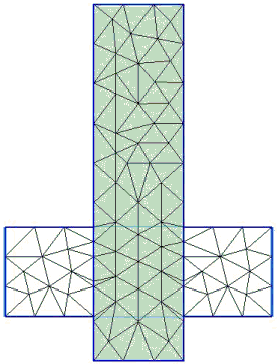
For example, if a blue rectangle (a thin metal) has a lower precedence value than a green rectangle (a thick metal), so its material (blue) takes priority where the two come in contact.
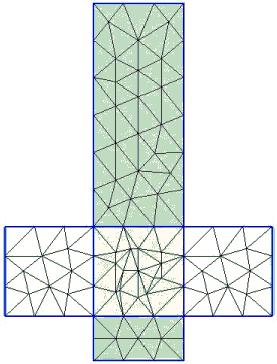
But in this next example, the blue rectangle has a higher precedence value than the green rectangle, so now the green material takes priority.
Following is a 3D view of the first preceding example (e.g., where the blue rectangle has the higher precedence value).