Transient Simulation of Ground Penetrating Radar
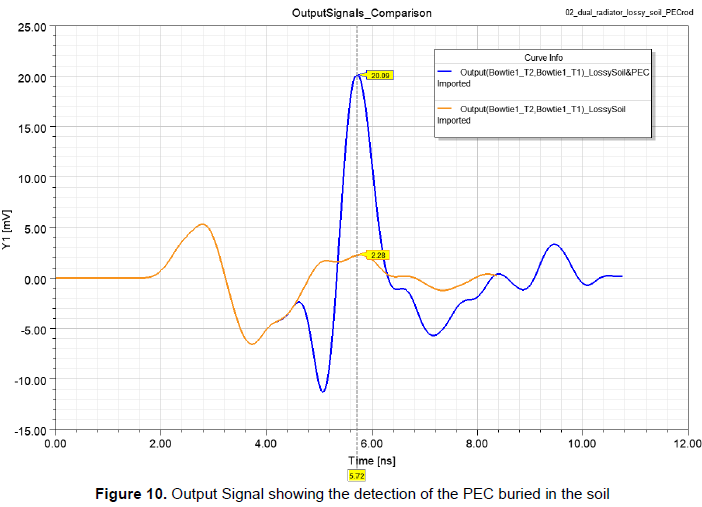
This example demonstrates a transient simulation setup in Ansys HFSS. The project models a ground penetrating radar to detect a PEC rod buried in a lossy soil environment. The project consists of two designs: 01_dual_radiator_lossy_soil models lossy soil environment. 02_dual_radiator_lossy_soil_PECrod models the lossy soil environment when the PEC rod is buried. Note that the geometry of the two designs is identical. However, the rod in the first design is assigned soil (the same as environment). The reason is to have identical geometry to be able to import the mesh from the first design into the second design. Therefore, we remove any effect of possible different mesh. That means in comparing the results of the two design, any difference is associated to different material properties of the PEC rod (what radar would detect). The Georadar_Transient pdf provides details for using the model.
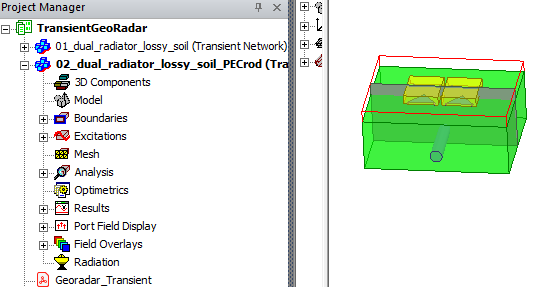
The Ground Penetrating Radar (GPR) design consists of two cavity backed bow-tie type antennas, one for transmission and one for reception, Figure 1. Each corner of the antenna is loaded with a 200 Ohm resistance model by an RLC boundary condition, Figure 2. This lump resistance helps improve the bandwidth of the antenna input impedance. The antenna is also enclosed in a rectangular conducting cavity to reduce direct coupling and unwanted radiation into air.
The solution type for this example is set as Transient with Network Analysis as Driven Option, Figure 3. By implementing a transient simulation, we can apply a time domain input signal (e.g. Gaussian Pulse) as either TDR or Broadband Pulse. In addition, excitations are identical in all active ports and are simulated one at a time to facilitate the data collection. To properly model the electrical properties of the ground soil the effect of the moisture contents of the earth needs to be accounted for. These are recorded as frequency dependent properties affecting the permittivity and conductivity.