HFSS SBR+ Hybrid Reflector Antenna Simulation Example
Description - HFSS SBR+ can provide significant time and memory savings for computing large reflector interaction. Most asymptotic solvers hybridize only to MoM codes. HFSS SBR+ hybridizes to both FEM and IE methods simultaneously. HFSS SBR+ can be hybridized to FEBI and IE Regions. FEBI or IE Regions may have sources, or be source-free regions. In this example, all full wave regions are first pre-computed, then applied to SBR+ Regions. All full wave regions (FEBI, IE) are considered independently. In practice, closely-spaced (near field) full wave regions should be grouped so that their 2-way couplings are considered prior to hybridization to SBR+ Region. Results exhibit comparable accuracy to IE simulations.
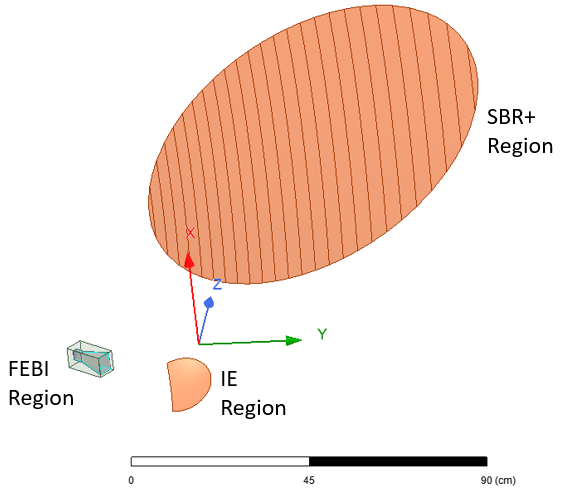
Model - The model is a 10 GHz Gregorian reflector system created with the Antenna Design Toolkit that is embedded with HFSS in the Ansys Electronics Desktop. The horn is set to FEBI, and the reflectors are set to IE Hybrid Regions. The largest reflector is changed to SBR+ Hybrid Region.
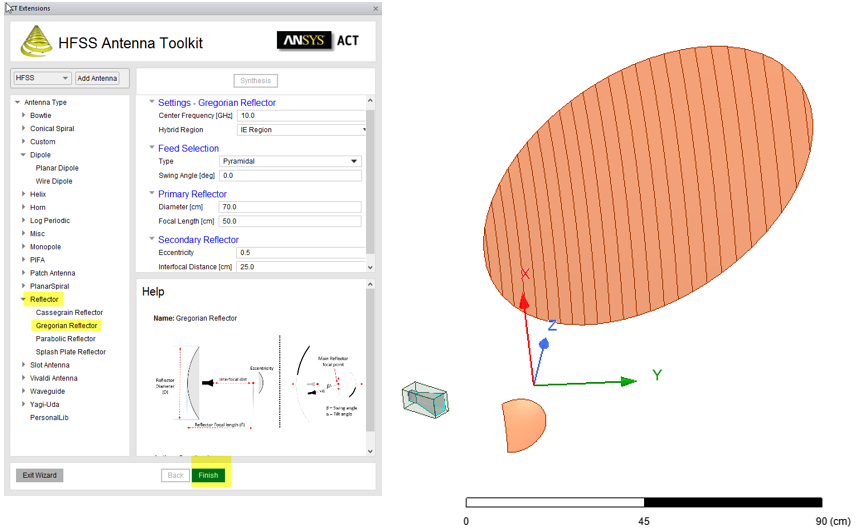
Full-wave meshing should be used for reflectors close to feed apertures.
- Horn: HFSS FEM (FEBI boundary)
- Subreflector: IE Region
Large reflector can use HFSS SBR+ to speed up simulation dramatically
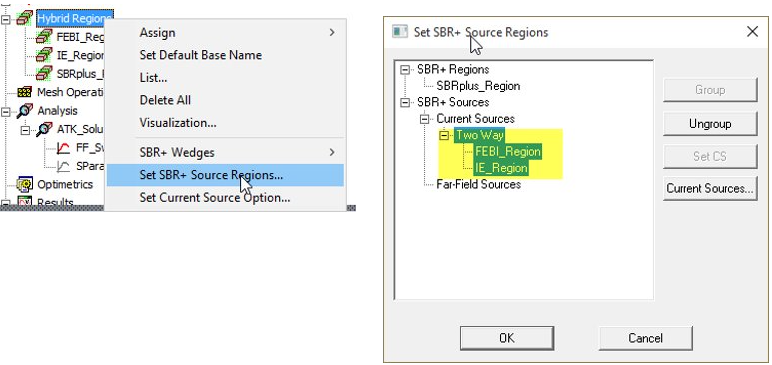
Set Two-way Interactions for full wave hybrid regions- •By default, full-wave regions will operate on the SBR+ Region independently. We want the FEBI and IE Regions to be simulated as coupled *before* applying them together to the SBR+ Region.
- Right-click on “Hybrid Regions” to select the Set SBR+ Source Region...
- Make sure the FEBI and IE Regions are grouped under “Two Way” sources
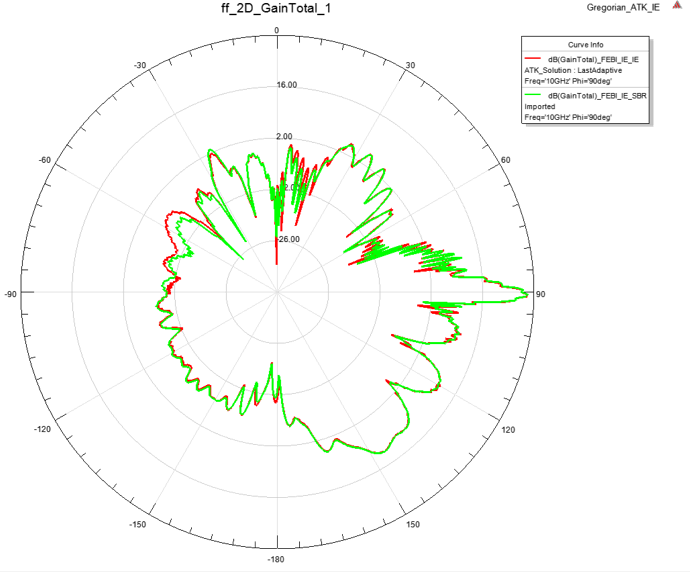
Results: If you compare a FEBI + IE Regions simulation with a Hybrid FEBI + IE + SBR+, there is excellent agreement. Using SBR+ reduces the overall simulation time (including FEB/FEBI and IE meshing by 63%.
- Reduction grows exponentially with electrical size of the problem.
- SBR+ makes it practical to simulate installed sidelobes for antenna system and its host platform (satellite payload, etc.)