Resistor Parasitic Capacitance
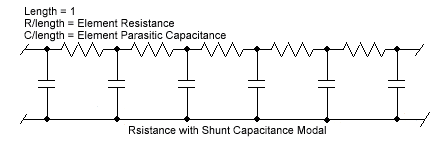
Active filters in integrated circuit design that use real physical resistors must contend with parasitic shunt capacitance associated with each resistor. Since the shunt capacitance tends to be distributed across the resistor surface, an acceptable model is a unit length RC transmission line. FilterSolutions permits the selection of this shunt capacitance for analysis purposes by selecting, "Real Parameters", deselecting "Ideal Resistors", and entering the desired default shunt capacitance in the text entry to the right of the checkbox.
Updates to Parasitic Shunt Capacitance
Since the parasitic shunt capacitance may not be the same for each resistor, parasitic shunt node capacitance may be updated by left clicking on a resistor and entering the desired shunt node capacitance for the selected resistor in the pop-up Change Control Panel.
Display of Parasitic Shunt Capacitance
The active circuits display shows the parasitic shunt capacitance value near each resistor that has a nonzero parasitic shunt capacitance value assigned. The active filter netlist also includes the parasitic shunt node capacitance values for external analysis, modeled as a unit length RC transmission line.
Parasitic Shunt Capacitance model
Parasitic shunt capacitance models unit length transmission lines. The length of the line is one, and the R/length and C/length are set to the actual resistance and parasitic values, so that the net R and C on the line exactly match the actual resistance and parasitic capacitance. L/length and G/length are set to zero.
Since L is zero, the speed of the line, 1/sqrt(LC), is infinite, so the RC transmission line may be set to any length desired, so long as the net R and C equate to the actual element resistance and parasitic capacitance. A unitless line length of one is convenient.