
Lumped Element Models
Stubs that are used to simulate lumped elements may be converted to the lumped elements they are simulating with the use of the right mouse key. Full lumped parasitic analysis is supported.
In addition to finite Q, series and parallel resistance parasitics and reactive parasitics are also modeled. Select Parasitics tab in the main Lumped control panel to enter default values. Series inductor resistance is sometimes referred to as DC series resistance (DCR) and series capacitor resistance is sometimes referred to as equivalent series resistance (ESR). Capacitors support series inductor parasitics, and inductors support parallel capacitance parasitics.
Like finite Q, the analysis is available in the schematic analysis and amplitude equalization is available to mitigate the lossy parasitic effects.
The following models are used for analysis purposes when series, parallel, and/or finite Q effects are entered.
Inductors
The model elements of Q resistance, series resistance, parallel resistance, parallel capacitance and inductance are arranged according to the following inductor model
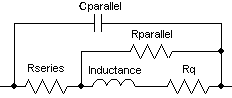
Inductor model with Parasitic Effects
Rq is computed as a function of frequency: Rq = (L*W)/Q where L is inductance in Henries, and W is frequency in R/S
Capacitors
The model elements of Q resistance, series resistance, parallel resistance, and series inductance capacitance are arranged according to the following capacitor model.
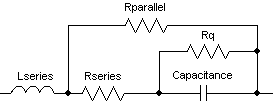
Capacitor model with Parasitic Effects
Rq is computed as a function of frequency: Rq = Q/(C*W) where C is capacitance in Farads, and W is frequency in R/S