
Leap Frog Active Filters
Leap frog active filters are active simulations of passive LC filters. The advantage in doing this is that equally terminated passive LC filters distribute the element value error over the entire filter, which in turn has the effect of minimizing adverse effect of element value errors on the frequency response. If such a filter is simulated in an active filter, then the synthesized active filter is expected to exhibit similar robust qualities.
Leap frog filters are relatively simple to create for all pole low pass and band pass all pole filters. The design complexity is greater for other forms of filters. Currently, band pass Leap Frogs are limited to all-pole designs. Low pass and high pass Leap Frogs support all-pole, as well as imaginary transmission zeros, such as in Elliptic as well as Butterworth and Chebyshev with manual imaginary zeros.
Alternate Topology Checkbox (available for low pass and high pass only) reverses the gain sign of each section in the filter. This results in an overall gain change for odd order filters, and greatly effects the tx zero topologies for filters with transmission zeros.
Synthesis of Filters
FilterSolutions uses the synthesis algorithm from Filter Theory and Design, Active and Passive by Sedra & Bracket, pages 714 to 721, ISBN 0-916469-14-2 for low pass and band pass all-pole designs.
Essentially, a string of integrators alternating between positive unity gain and negative unity gain. Positive gain stages are implemented with a Miller integrator to maximize performance with real opamps. Each integrator output has a feedback and a feed forward resistor. The end integrators have additional resistors to account for the terminations. In the case of even order Chebyshev filters that are not modified for even order passive implementation, the value of the source resistor is calculated to be the maximum obtainable value that is less than the load resistor. The values of the feedback and feed forward resistors are calculated from the prototype LC filter and resistive constant entered by the user. The capacitor values of the leapfrog filter are calculated from the cutoff frequency of the filter and resistive constant entered by the user.
The following is a 4th order low pass LC passive Butterworth filter prototype.
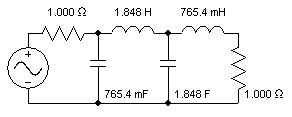
Passive LC Ladder
The element values, cutoff frequency, and user entered resistive constant are used to calculate the feedback, feed forward, and end piece resistors of the following Leap Frog filter:
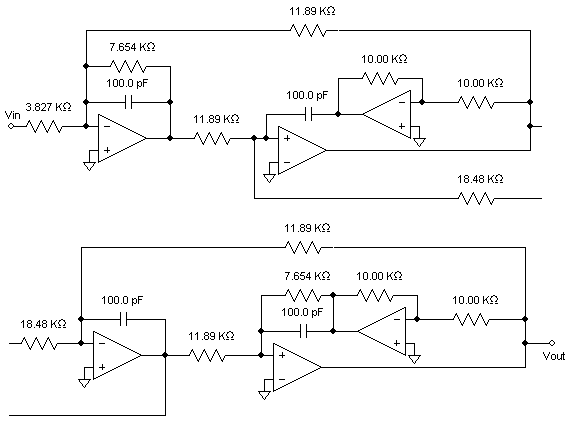
Equivalent Leap Frog Active Filter
High pass designs use differentiaters instead of integrators. Transmission zeros utilize both a differentiater and an integrator.