
Elliptic Filters
The Elliptic Filter contains a Chebyshev Type I style equiripple pass band, an equipped stop band, a sharp cut off, high group delay, and greatest stop band attenuation.
Like the Chebyshev Type I Filter, the Elliptic pass band attenuation is defined to be the same value as the pass band ripple amplitude. However, FilterSolutions allows the user the option of selecting any pass band attenuation in dB's that will define the filters cut off frequency.
Derivation:
The equations shown in the Chebyshev I and II filters are used iteratively until a K(S) is established that maintains an equiripple in both the pass band and the stop band. The transfer function is then

using left half plane poles only.
Constricted Equiripple Passband
The performance of Elliptic filters (and also Chebyshev I filters) may sometimes be improved by constricting the equiripple to a percentage of the passband near to the cutoff frequency. FilterSolutions provides for a "Constrict Equiripple" function to accomplish this. If the passband performance away from the cutoff frequency is not an issue, it is sometimes possible to reduce the required order of the filter by constricting the ripple.
See Constricted Equiripple Passbands in the Help for more information and examples.
Frequency Asymmetrical Elliptic Band Pass Filters.
Band pass Elliptic filters may have the high pass and low legs set independently. Figure 1 illustrates a frequency asymmetrical Elliptic filter, 5th order low pass, 11th order high pass filter with the low pass and high pass legs set to 40dB and 80dB of attenuation respectively.
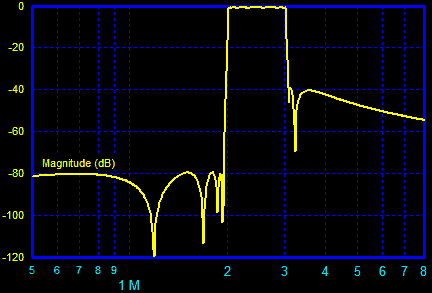
Figure 1: Frequency Asymmetric Elliptic Filter