
Active Band Pass Architectures
FilterSolutions offers two ways to architect the active band pass filter: integrated band pass architecture and high pass/low pass architecture. The differences produce different element values and stage gains for the band pass stages. In the integrated architecture, all stages in the filter are 2nd order band pass stages. The high pass/low pass architecture uses high pass and low pass stages. Odd order high pass/low pass architectures also use one band pass stage. One significant advantage of the high pass/ low pass architecture is if poles exist on the real axis, they may be absorbed into other biquads resulting in a savings of one opamp.
The two different architectures are produced by rearranging the stage transfer function numerators. The integrated architecture uses a single zero in each stage of the filter. The high pass/low pass architecture places two zeros in half the stages, and no zeros in half the stages. The total number of zeros is the same for both architectures.
Which Architecture to Use:
In general, the integrated band pass architecture works better for narrow band filters, and the high/low pass architecture works better for wide band filters. This is due to potentially huge, undesirable gains that may saturate opamps if the wrong architecture is used.
Illustration:
To build a 3rd order filter with corner frequencies of 1000 and 5000 Hz, the following cascade transfer function may be used:
Both transfer functions are identical in performance. The only difference is the distribution of zeros among the stages.
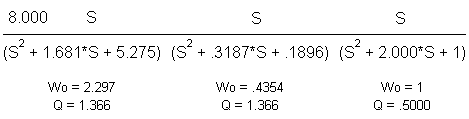
Integrated Band Pass Architecture
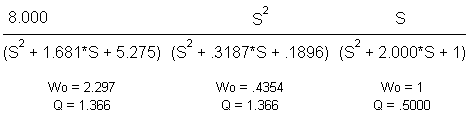
High Pass/Low Pass Band Pass Architecture
The transfer functions shown above each produce unique active circuit architectures shown below
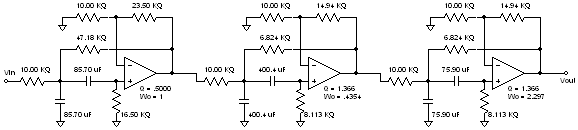
Integrated Band Pass Architecture
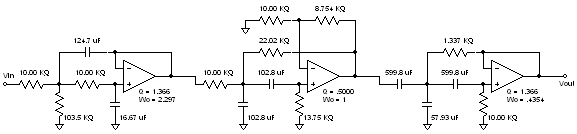
High Pass/Low Pass Band Pass Architecture
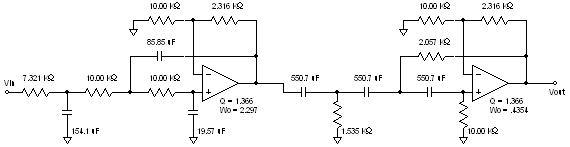
High Pass/Low Pass Architecture With Real Poles Absorbed