
Akerberg-Mossberg Biquad
The Akerberg-Mossberg biquad exceeds the performance of the Thomas biquads for opamp imperfections and matches the Thomas 2 biquad notch performance in the presence of element value errors. This increased performance is obtained by replacing the positive integrator in the Thomas 2 biquad second and third opamps with a Miller integrator. The Miller integrator uses two matched opamps in a configuration that tends to cancel errors due to opamp imperfections.
The output of the Akerberg-Mossberg biquad may be from any of the three opamps.
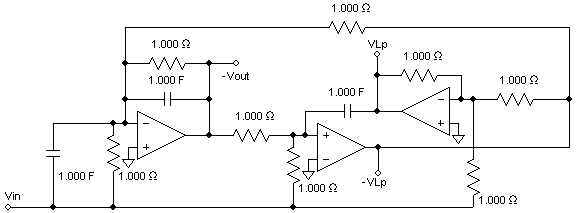
Akerberg-Mossberg Biquad
Miller Integrator
The opposing second and third opamps in the Akerberg-Mossberg biquad shown above constitute the Miller integrator. The outputs of the two opamps are equal and opposite. If matched opamps are used in the Miller integrator, this opposing arrangement tends to cause errors due to opamp imperfections to cancel, and thereby create a high quality output signal for the biquad as a whole.
| Biquad | Advantages | Disadvantages |
|---|---|---|
|
Akerberg-Mossberg |
|
|