
Two-Tone HB with NLAMP
Inter-modulation distortion (IMD) is typically measured with a spectrum analyzer by first injecting a two tone signal into the device , then measuring the resulting inter-modulation product signals. The two tones freq1 and freq2 are very close to each other. This ensures that the 3rd order products (2*freq1 – freq2 and 2*freq2 – freq1) are generated very close to the fundamental. Thus their effects can be seen even when the amplifier is operating in a narrow band.
For the two-tone harmonic balance analysis, two simusoidal power sources connect to input Port 1:
- PowerSinusoidal1 supplies power pin (20dB) at frequency freq1 (1.96GHz).
- PowerSinusoidal2 supplies power pin (20dB) at frequency freq2 (2.06GHz).
- Expand the Analyses icon and double-click on HBnTone.
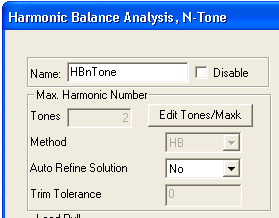
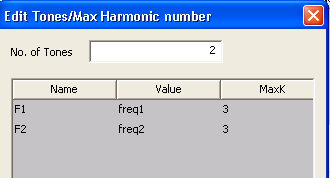
Click Edit Tones/Maxk to view the frequency setup, three harmonics each of freq1 and freq2.
- With analysis HBnTone still selected, right-click and select Analyze. The analysis runs to completion.
- Click the Results icon and double-click two_tone to see the results:
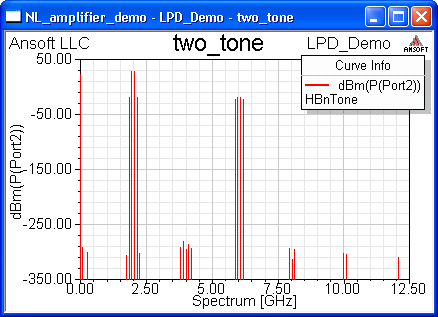
The two_tone report shows the two fundamental components corresponding to freq1 (1.96 GHz) and freq2 (2.06 GHz) to be dominant, followed by the third order terms 2*freq1 – freq2 (1.86 GHz) and 2*freq2 – freq1 (2.16 GHz). Since the input power for both the sources is the same, the amplitudes of the two fundamental and the two third harmonic components are identical.