
Renormalized S-Matrices
Before a generalized S-matrix can be used to compute the reflection and transmission of signals, the generalized S-matrix must be normalized to the chosen impedance. For example, if a generalized S-matrix has been normalized to 50 ohms, it can be used to compute reflection/transmission directly from signals normalized to 50 ohms:
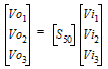
where:
- The input signals, Vii, and output signals, Voi, are both normalized to 50 ohms.
- To renormalize an S-matrix to a specific impedance, the system calculates a unique impedance matrix associated with the structure.
The unique impedance matrix, Z, is:

where:
- S is the nxn generalized S-matrix.
- I is an nxn identity matrix.
- Z0 is a matrix with the characteristic impedance of each port as a diagonal value.
The renormalized S-matrix is then calculated from Z using this relationship:

where:
- Z is the structure’s unique impedance matrix.
- ZW and YW are matrices with the chosen impedance and admittance as diagonal values.
Visualize the generalized S-matrix as an S-matrix that has been renormalized to the characteristic impedances of the structure. Therefore, if a diagonal matrix containing the characteristic impedances of the structure is used as ZW in the previous equation, the result is the generalized S-matrix again.
S-matrices for modes other than the dominant one cannot be renormalized or used in circuit simulators.