


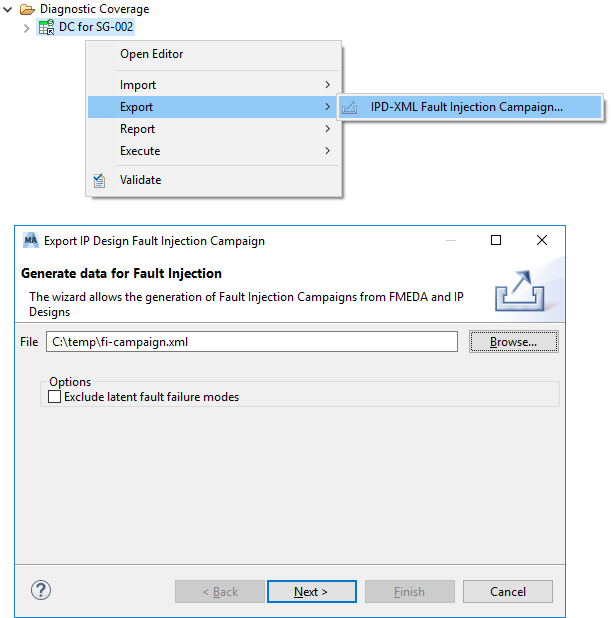
| Fault Injection Campaign | The determination of (random) runtime faults and their detection is at the core of any FMEDA analysis (e.g. SPF/LF metrics of ISO 26262, SFF of IEC 61508). Version 2019 R2 introduced new features to use Fault Injection for DC validation of chip designs. The IPD-XML format version 1.2 now supports the export of failure modes and safety mechanisms to drive a fault injection run. Later the result can be imported back to update the analysis based on the measured DC values. There is a new export option at DC / FMEDA worksheets to start an IPD-XML export to feed a fault injection run.
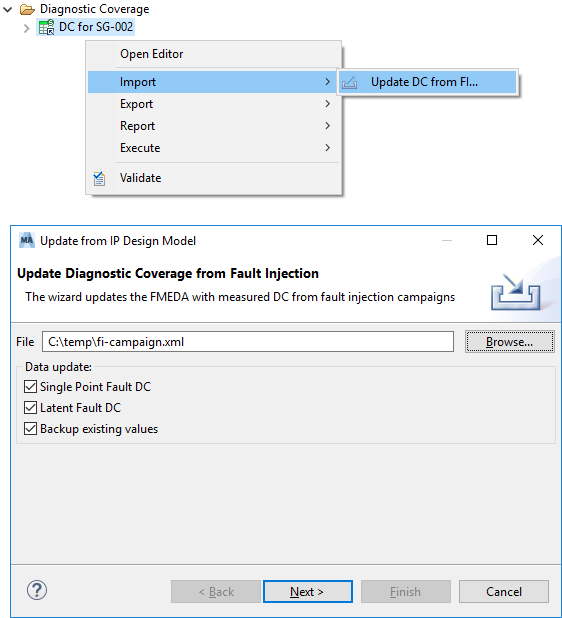
Once the fault injection run has finished, the measured DC values can be imported back to the FMEDA / DC worksheet. A new import option is available at worksheets to import IPD-XML files enriched with updated DC data.
|
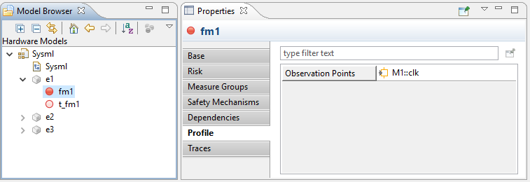
| Observation and Diagnostic points | Observation points can be annotated to failure modes, basically references to system elements like ports in the IP design at which the potential failure mode is observed. Safety mechanisms can also reference system elements as diagnostic points, so basically ports or other instances in the IP design at which the detection or correction of the failure mode is observed ("flagged").
|
| Delta Aggregation | There is a new option in the Failure rate Aggregation wizard to exclude overlapping allocations from the area/sequential elements aggregation. This new option supports cases, if a few elements in an IP sub-hierarchy should be excluded and aggregated at a different part.
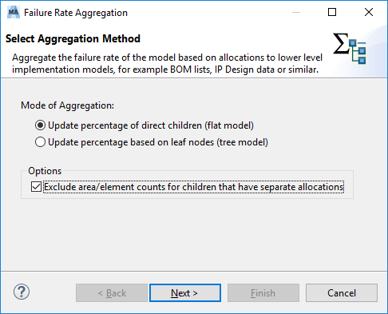
Furthermore the aggregation wizard also aggregates "Cell Count" and "Gate Count" in the same way as "Sequential Elements. Aggregated numbers are shown on the result page. |
| IPD-XML Import | The IPD-XML import now supports the official revision 1.2 (Schema version 1.1) which supports fault injection exchange. |