


| Failure Rate Prediction Automation | The new version comes with an automated failure rate prediction feature so that HW part libraries can be built faster or failure rates for a PCB part list can be quickly determined. If you have an export from Ansys Sherlock, an AVL, or BOM in CSV/Excel which includes a component category information, you can leverage the new feature and derive failure rates based on any builtin failure rate handbook with just a few clicks (e.g. SN29500, IEC 61709, 217Plus, etc.).
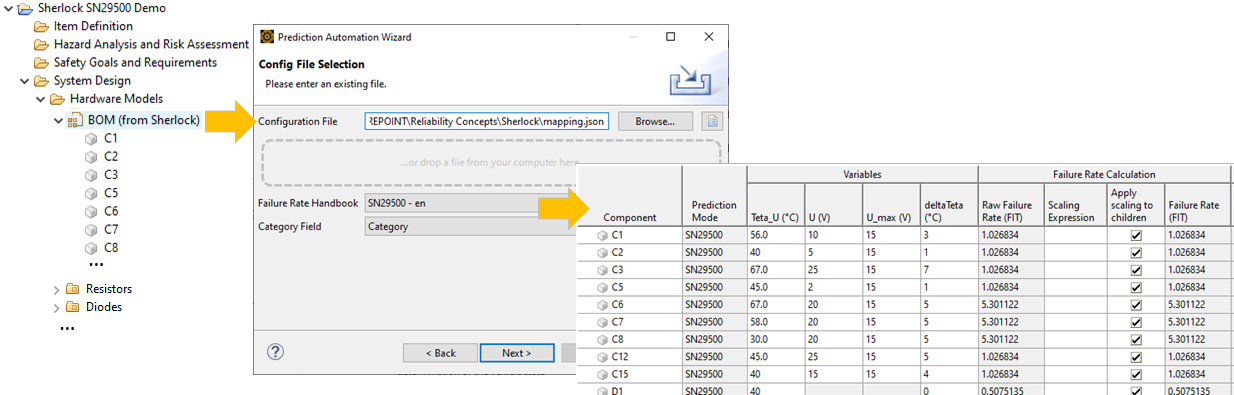
This feature is enabled by an easy to setup config file which allows you to customize the lookup of handbook data and also assign useful defaults for stress parameters. |
| Failure rates for Malfunctions | While medini strictly distinguishes failure modes with failure rates (at structural elements) and malfunctions without failure rates (at behavior elements of models), sometimes it is useful to receive failure rates on the latter, especially if you connect an FTA at the functional level. For this purpose a new (derived) failure rate field is available at malfunctions that gives you exactly the failure rate of all causes of the next lower level.

|
| Conditional propagation of failure rates | The failure net has usually not a strict quantitative semantics, but it is often useful to propagate failure rates from one level to the next, e.g. to connect FMEDA with FTA. The beta factor attached to failure relations models the conditional probability and hence is now also considered during "sum of causes" calculations for failure modes. Important: This feature is a change that might affect your existing models. You will receive a migration warning if your project would be affected. In any case, the change will be effective only if you recompute failure rates after migrating to 2021 R2. |