


Sandwich Panel model
Background information and instructions for using the Synthesizer tool's Sandwich Panel model, with links to more details about the underlying model.
This document is only available to customers with an Ansys ID.
The Sandwich Panel model predicts the performance of lightweight sandwich structures, consisting of a core material bonded to two face-sheets. These structures are used in weight-critical applications, such as transportation vehicles.
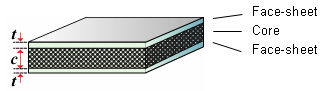
When a monolithic material is loaded in bending, the top surface is subjected to tensile loads and the bottom surface to compressive loads. These loads, which are at a maximum at the outer surfaces, reduce to zero at the neutral axis. In contrast, the shear loads, which are zero at the outer surfaces, reach a maximum at the neutral axis.

As the level of shear loading is typically an order of magnitude lower than the tensile/compressive loads at the outer surfaces, the performance of a monolithic material in bending is generally dictated by its tensile and compressive properties. This typically results in an inefficient use of material as only the outer surfaces of the component are exposed to the design load. Sandwich panel structures overcome this inefficiency by utilizing the stress distribution, and use lightweight, low performance materials in the core, and stiff, strong materials for the face-sheets. This enables the mass of the component to be minimized with little, or no, loss in performance.