
Butterworth Filters
The Butterworth Filter is the filter type that results in the flattest pass band and contains a moderate group delay.
A standard Butterworth Filter's pass band attenuation is -3.01dB. However, FilterSolutions allows the user the option of selecting any pass band attenuation in dB's that will define the filters cut off frequency.
FilterSolutions also offers the user the option of placing user-defined zeros in the stop band. Such a filter with stop band zeros is no long a true Butterworth Filter, but is still in the Maximally Flat filter family.
Derivation:
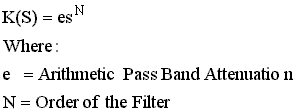
The characteristic equation for the Butterworth filter is
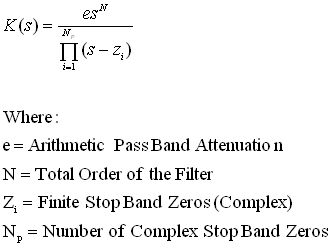
The addition of stop band zeros, generally referred to as a "Maximally Flat" filter, modifies the characteristic equations to be:
Asymmetrical Band Pass filters
In the case of asymmetrical band pass filters, the low pass prototype cannot be used. The characteristic equation is then,
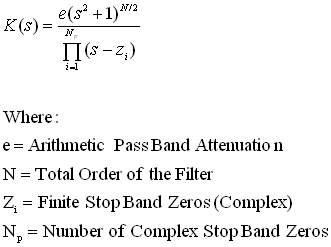
Note that the band width of the functions is essentially set by the variable "e". Iterations are generally required to set the band width to the desired width at the specified attenuation.
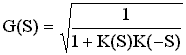
Using half plane poles only, he transfer function is:
If zeros are assigned to the filter, the zeros are placed in polynomial form in the denominator of the characteristic equation.
Stop band zeros may be placed anywhere on the JW axis outside the stop band or anywhere on the real axis. To enter real zeros, add the suffix "re" to the frequency value to indicate real.