
Mesh Quality and Type
The quality of the mesh is one of the most critical aspects of a CFD model. A good mesh is essential for a good solution. A good mesh requires proper resolution, smoothness, low skewness, and an appropriate number of elements. The main requirements can be summarized as follows:
- The mesh must be fine near objects where the gradients of temperature and velocity may be very large (for example, heated blocks or plates, cabinet walls with nearby objects).
- The expansion ratio from one mesh element to the next should be kept in the range between 2 and 5, although in some critical areas a lower value might be better.
- An equilateral element (cube or equilateral tetrahedron) is optimal. Since it is generally not possible to have only optimal elements, you should instead focus on maintaining a low aspect ratio and regular (not skewed) shape for each element. This will reduce the number of long, thin elements and the number of distorted elements, both of which can decrease accuracy and destabilize the solution. Figure 1 shows examples of elements with low and high skew.
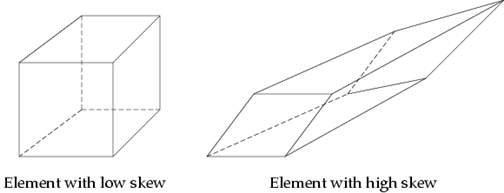
Fig. 1 Elements with Low and High Skew
- It is also possible to have non-conformal meshing in a certain region of the model to improve grid quality and/or to reduce the mesh count. A bounding box can be applied to a certain region, and the mesh inside this region need not match the mesh outside the region.
- For an efficient calculation, the mesh should be coarser in areas where the gradients of velocity and temperature are small. Since there are no small changes in flow behavior to be captured, it would be wasteful to have a fine mesh in such regions. The cost of the calculation will be directly proportional to the number of elements in the mesh, so it is best to concentrate the elements where you need them, and reduce the number of elements elsewhere.