


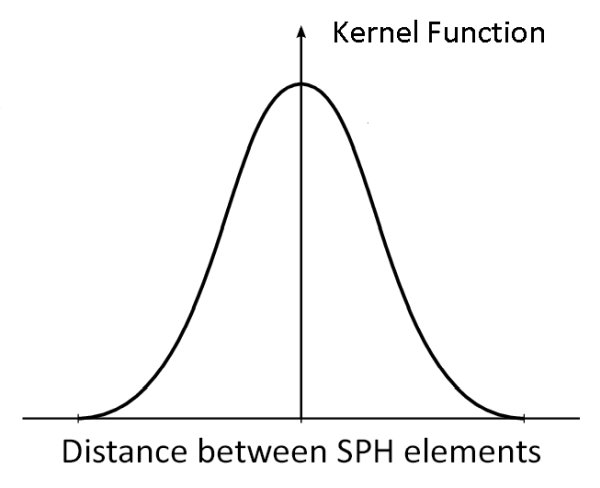
As described in the previous section (Overview of SPH), the kernel function is the core of the SPH method as it dictates how a local fluid property is computed based on the neighboring SPH elements. As shown in Figure 2.1: Kernel function in relation to the distance between SPH elements., the kernel functions look like a Gaussian function but have compact support, being equal to zero above certain pre-set values of the argument, which is the distance between SPH elements. This maximum interaction distance is called the kernel radius.
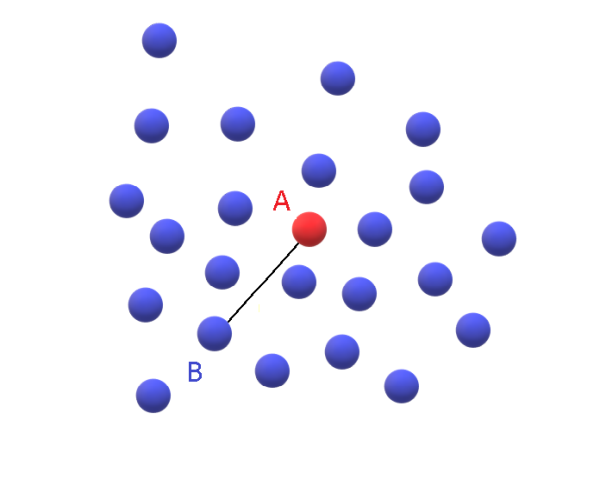
As illustrated in Figure 2.2: SPH elements A and B interact if the distance between them (black line) is within the kernel radius., two SPH elements A and B will interact only if the distance between them is less than the kernel radius. The strength of the interaction also depends on this distance.
Figure 2.2: SPH elements A and B interact if the distance between them (black line) is within the kernel radius.
Many kernel functions were proposed by the SPH community. For the method, the kernel function is defined by the option, which is a method parameter. The three available options for kernel functions are the Cubic, Quintic, and Wendland functions, the latter of which is the default option. These functions are given by equations Equation 2–5, Equation 2–6 and Equation 2–7 respectively:
 | (2–5) |
 | (2–6) |
 | (2–7) |
where  is the kernel support distance (or smoothing distance), defined in Rocky as:
 | (2–8) |
where  is the initial SPH element spacing and
  is defined by the Kernel Dist. Factor
value, which is a method parameter. The default value of the Kernel Dist. Factor is
is defined by the Kernel Dist. Factor
value, which is a method parameter. The default value of the Kernel Dist. Factor is 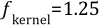 .
.
The  parameter used in the three kernel function equations is defined as:
 | (2–9) |
where  is the distance between two neighboring SPH elements.