
Mixer Products
Mixer Products are a class of Rx spurious responses that result from the nonlinear mixers present in the frequency conversion stages of a receiver. If a receiver's first intermediate frequency (IF) and mixing mode is known, then EMIT can compute the location of these mixer products and include them in the Rx susceptibility profile.
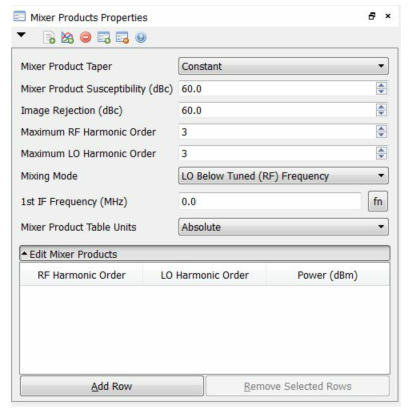
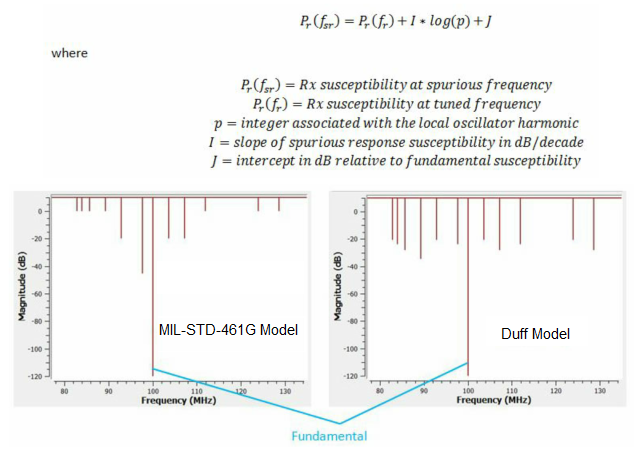
Mixer Product Taper: EMIT offers several tapers that can be optionally applied to the Rx Spectral Profile mixer products. The tapers determine the amplitude of each of the mixer products. If Constant is selected, the amplitude of the mixer products is set at a constant amplitude relative to the fundamental. The MIL-STD-461G model applies the limits defined in MIL-STD-461G to the mixer product amplitude levels. The Duff Model determines the amplitude level of the Nth mixer product based on:
Mixer Product Susceptibility (dBc): If Constant is selected for the mixer product taper, the mixer product susceptibility determines the amplitude (above the fundamental) of the mixer products.
Mixer Product Slope (dB/decade): Used by the Duff Model only, the mixer product slope is I in the equation above. It determines the rate at which the amplitude of the local oscillator harmonics decrease and is defined in dB/decade.
Mixer Product Intercept (dB/decade): Used by the Duff Model only, the mixer product intercept is J in the equation above. J is determined from a statistical analysis of the receiver and is specified in dB above the fundamental sensitivity.
Minimum Tuning Frequency: Only visible if MIL-STD-461G is selected as the mixer product taper. This is the minimum tuning frequency for the receiver band.
Maximum Tuning Frequency: Only visible if MIL-STD-461G is selected as the mixer product taper. The bandwidth at which the Rx Band's susceptibility envelope is 80 dB above the in-channel susceptibility level. The equation for determining the level of the mixer products when using the MIL-STD-461G taper is:
80 dB Bandwidth: Only visible if MIL-STD-461G is selected as the mixer product taper. This is the minimum tuning frequency for the receiver band.
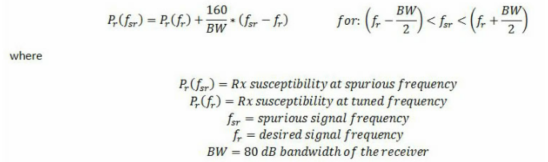
Image Rejection (dBc): Defines the Rx susceptibility level at the Image Frequency. The image frequency is given by:

where f is the tuned channel frequency.
Spurious Rejection (dBc): Used for DD-1494 mode only, the spurious rejection defines the Rx susceptibility level for all mixer products except the Image Frequency.
Maximum RF Harmonic Order: Maximum value to use for m when computing mixer products, where:
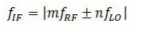
Maximum LO Harmonic Order: Maximum value to use for n when computing mixer products. The effect of increasing the RF and LO maximum harmonic orders is shown below for m=n=3 (left) and m=n=6 (right):
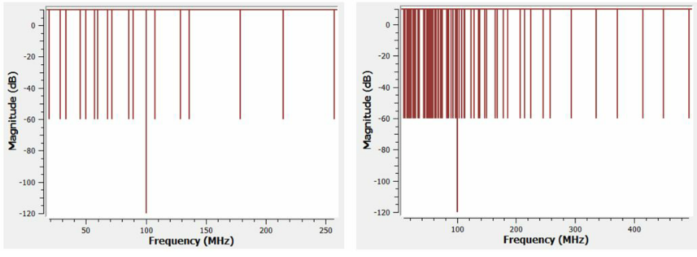
Mixing Mode: Defines the relationship between the RF (tuned channel), IF and LO frequencies. There are three options here:
LO Above Tuned (RF) Frequency: Use when the LO frequency is above the tuned channel frequency:

LO Below Tuned (RF) Frequency: Use when the LO frequency is below the tuned channel frequency:

LO Above/Below Tuned (RF) Frequency: This setting is used when the LO frequency is above the tuned channel frequency over part of the Band and below it for the other part. In this case two additional parameters will appear as shown below to define where the transition from high LO to low LO occurs. The Use High LO setting tells EMIT whether the LO frequency is higher than the tuned channel frequency (LO Above Tuned (RF) Frequency) or below the RF Transition Frequency.

1st IF Frequency (MHz): The intermediate frequency for the radio's first conversion stage. For receivers that have a non-constant IF that depends on the tuned channel (RF) frequency, an expression can be used to define the IF using the Expression Editor.
Mixer Product Table Units: Specifies the units used for the power level defined in the table. The power can be entered in either absolute power or relative to the tuned channel's "peak" susceptibility level.
Add Row: Add a row to the table. The tuned channel and image frequency (RF Order = +/-1, LO Order = 1) are not configured in the table. The image frequency spur is configured by the Image Rejection parameter, and the tuned channel susceptibility is configured by the Rx Spectral Profile parameters or the Selectivity table.
Remove Selected Rows: Delete the selected rows from the table.