


Torus Surface
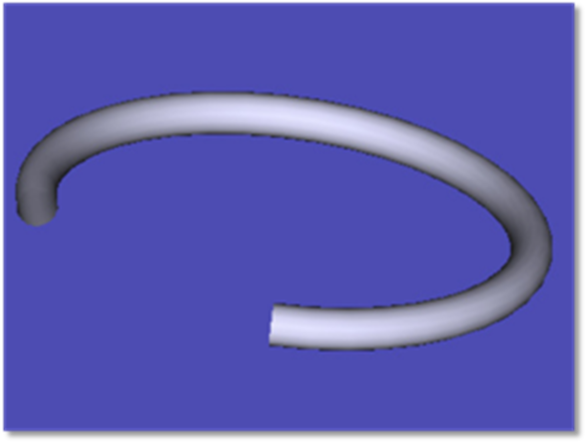
A torus is a circle rotated about a displaced axis. The rotation about the displaced axis may be over a full 360 degrees; or just some subset of that angular range. This object can be used to model optical fibers or curved light pipes. See also the discussion of the Torus Volume for modeling refractive solid torus shapes.
The torus surface is defined by 4 parameters:
| Parameter # | Description | Face Name | Face # |
| 1 | The radius of rotation about the Y axis of the circle, R. | All Faces | 0 |
| 2 | The radius of the circle, r. | All Faces | 0 |
| 3 | The start angle of the torus, θ1. | All Faces | 0 |
| 4 | The stop angle of the torus, θ2. | All Faces | 0 |
The circle lies in the YZ plane with the center of the circle at x = 0, y = 0, and z = R. This position of the circle corresponds to the rotation angle θ = 0. The angles of rotation are about the Y axis and must meet this condition:
0 ≤ θ1 ≤ θ2 ≤ 360
There is also the restriction that R > r; otherwise, a closed volume or a smooth surface will not result. The reference coordinate is the center of the axis of rotation. Face Numbers: All faces Face 0.
Next: