


Apodization Type
Uniform Rays are distributed uniformly over the entrance pupil, simulating uniform illumination. By default, the pupil is always illuminated uniformly.
Gaussian Imparts an amplitude variation over the pupil that is Gaussian in form. The apodization factor refers to the rate of decrease of the beam amplitude as a function of radial pupil coordinate. The beam amplitude is normalized to unity at the center of the pupil. The amplitude at other points in the entrance pupil is given by

where G is the apodization factor and ρ is the normalized pupil coordinate. If the apodization factor is zero, then the pupil illumination is uniform. If the apodization factor is 1.0, then the beam amplitude has fallen to the 1 over e point at the edge of the entrance pupil (which means the intensity has fallen to the 1 over e squared point, about 13% of the peak). The apodization factor can be any number greater than or equal to 0.0. Values larger than about 4.0 are not recommended. This is because most computations will sample too few rays to produce meaningful results if the beam amplitude falls too quickly at the edges of the pupil.
Cosine cubed Simulates the intensity fall off characteristic of a point source illuminating a flat plane. Note cosine cubed apodization is only useful and should only be used for point sources or field points close to the axis when compared to the entrance pupil diameter. For a point source, the intensity of a ray illuminating a differential area on a plane is given by

where  is the angle between the z axis and the ray intersecting the entrance pupil, and the relative intensity at the center of the pupil is 1.0. Converting to normalized pupil coordinates and taking the square root yields the pupil coordinate amplitude apodization
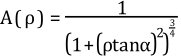
Where

is the tangent of the angle between the z axis and the marginal ray. OpticStudio uses the entrance pupil position and size to compute

The apodization factor is not used by the cosine cubed apodization.
If the aperture type is "Object Cone Angle" then a slightly different apodization technique is used. The apodization is achieved by careful selection of the ray cosines in object space. The resulting distribution is uniform in solid angle rather than angle space. The solid angle Ω of a sphere illuminated by a cone of angle θ is given by

The normalized radial pupil coordinate p is related to the fractional solid angle by
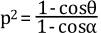
where α is the maximum cone angle defined by the system aperture value and θ is the angle of the ray with the normalized pupil coordinate p. This apodization will yield uniform ray density and power per solid angle everywhere over the defined cone.
User Defined OpticStudio also supports user defined apodizations on any surface, rather than just the entrance pupil. User defined surface apodizations are implemented using the user defined surface type described in "User defined surface apodization using DLLs".
Next: